How to track podcast downloads across every listening app

Nathaniel DeSantis
Podcast Analytics

Introduction
Your audience is scattered across Apple Podcasts, Spotify, Overcast, Pocket Casts, and a dozen apps you’ve never opened. If you want to track podcast downloads across every listening app, you quickly discover that no single platform dashboard even tries.
The fix isn’t checking five dashboards and doing spreadsheet math. It’s measuring at the one point all apps share: the moment they request your audio file.
This guide explains the fragmentation problem, how prefix-based measurement solves it, and the exact setup steps — which take about ten minutes.
Key takeaway
No platform dashboard sees your whole audience — each app reports only itself
Every app has one thing in common: it requests your episode’s audio URL
A URL prefix like OP3’s counts that request identically for every app
Setup: paste your RSS feed into BuzzyPod, add the prefix at your host, done
Listeners are completely unaffected — no migration, no feed change for them
The fragmentation problem
Podcasting is an open ecosystem, which is wonderful for listeners and mildly maddening for measurement. Each platform only reports its own slice:
Apple Podcasts Connect: followers and plays inside Apple’s app
Spotify for Creators: streams and consumption inside Spotify
Independent apps like Overcast and Pocket Casts: little or no creator-facing analytics at all
Your host: download estimates from its server logs, using its own proprietary filtering
Adding these together double-counts some listeners, misses others, and mixes incompatible units. It’s not a total; it’s a smoothie.
The insight: measure the request, not the app
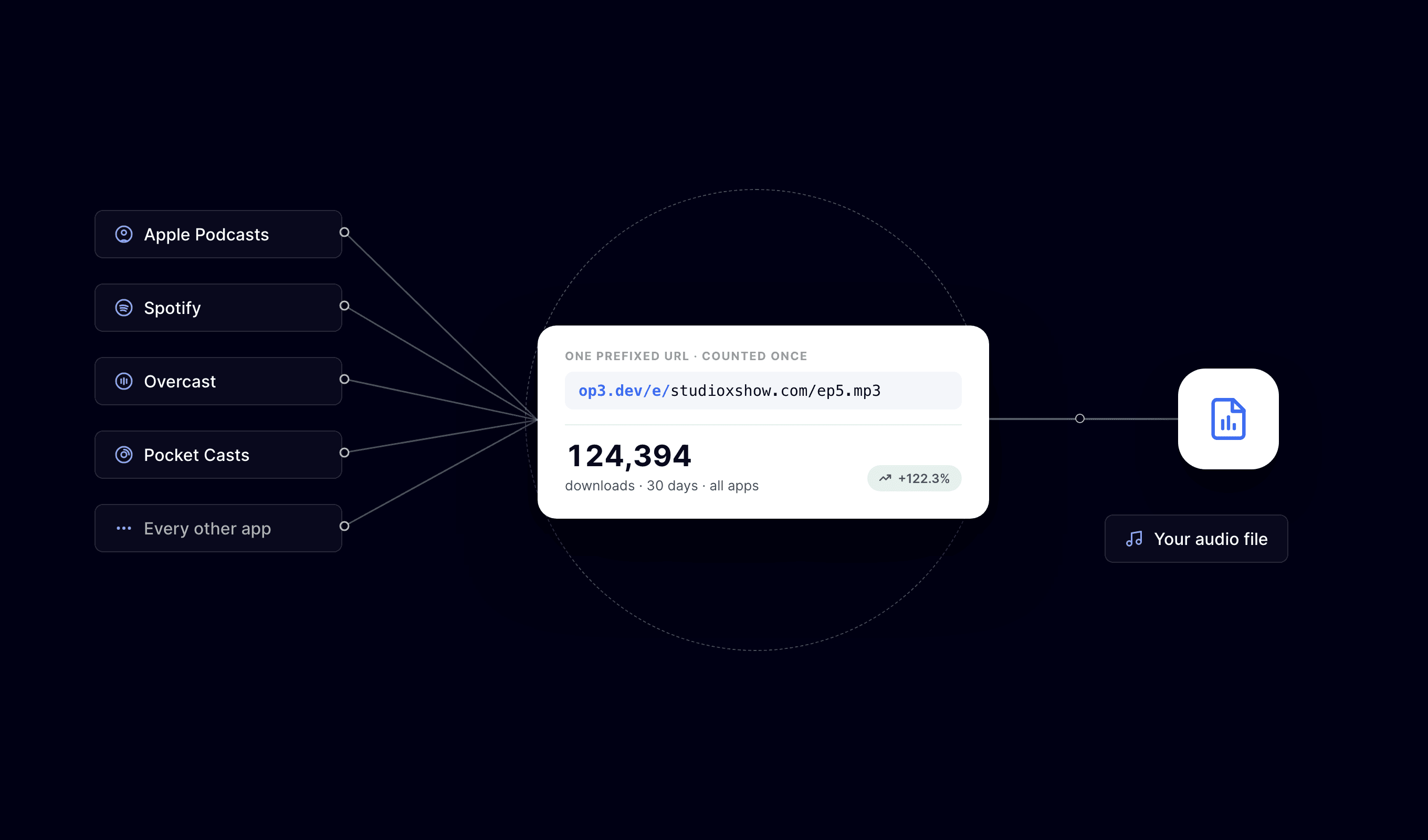
Whatever app someone uses, it does the same thing to play your episode: it requests the audio file at the enclosure URL in your RSS feed. That request is the universal event.
Prefix-based measurement puts a counter on that URL. OP3 — the open-source Open Podcast Prefix Project, launched in 2022 — adds op3.dev/e/ in front of your audio URL. Requests hit OP3, get counted, and instantly redirect to your file.
Every app goes through the same front door, so every app is counted by the same open rules. Downloads are filtered to industry standards, and OP3’s methodology is public code anyone can inspect.
Step-by-step setup
Here’s the whole process with BuzzyPod. No migration, no new host, no feed moves:
Paste your RSS feed URL into BuzzyPod — it reads your show and episodes from the feed
Add the OP3 prefix at your hosting provider — most hosts have an analytics-prefix field in their settings where you enter the prefix once
Publish as usual — new episode requests now flow through the prefix and get counted
Open your dashboard and watch downloads accumulate across every app
Your listeners notice nothing. Same apps, same subscriptions, same playback — the redirect adds no meaningful delay and changes nothing about the file they receive.
One honest caveat about history
Prefix measurement starts counting when the prefix goes live. It can’t retroactively count last year’s downloads, which is exactly why the best day to set it up was launch day and the second-best day is today.
What you’ll see once it’s running
With one consistent counting method in place, the interesting questions become answerable:
Total downloads with 7-day and 30-day change, so you know your real trajectory
A world map of listeners by country, down to US metro areas
Which listening apps and devices your audience actually uses
Per-episode download curves, comparable day-by-day from launch
And when a sponsor or co-host wants proof, one-click CSV exports beat screenshots of five dashboards that disagree with each other.
Keep the platform dashboards around, though. Apple and Spotify still offer engagement details — retention, follows, listening time — that download counting can’t see. The prefix number becomes your source of truth; the platforms become useful commentary on top of it.
Conclusion
Tracking downloads across every listening app isn’t about collecting more dashboards — it’s about measuring once, at the request level, with open rules. Ten minutes of setup replaces the weekly ritual of reconciling numbers that were never going to match.
BuzzyPod makes it painless: paste your RSS feed, add the OP3 prefix, and get the full cross-app picture for $10/month — with a 14-day free trial to see your own data first.
Related reading
Introduction
Your audience is scattered across Apple Podcasts, Spotify, Overcast, Pocket Casts, and a dozen apps you’ve never opened. If you want to track podcast downloads across every listening app, you quickly discover that no single platform dashboard even tries.
The fix isn’t checking five dashboards and doing spreadsheet math. It’s measuring at the one point all apps share: the moment they request your audio file.
This guide explains the fragmentation problem, how prefix-based measurement solves it, and the exact setup steps — which take about ten minutes.
Key takeaway
No platform dashboard sees your whole audience — each app reports only itself
Every app has one thing in common: it requests your episode’s audio URL
A URL prefix like OP3’s counts that request identically for every app
Setup: paste your RSS feed into BuzzyPod, add the prefix at your host, done
Listeners are completely unaffected — no migration, no feed change for them
The fragmentation problem
Podcasting is an open ecosystem, which is wonderful for listeners and mildly maddening for measurement. Each platform only reports its own slice:
Apple Podcasts Connect: followers and plays inside Apple’s app
Spotify for Creators: streams and consumption inside Spotify
Independent apps like Overcast and Pocket Casts: little or no creator-facing analytics at all
Your host: download estimates from its server logs, using its own proprietary filtering
Adding these together double-counts some listeners, misses others, and mixes incompatible units. It’s not a total; it’s a smoothie.
The insight: measure the request, not the app
Whatever app someone uses, it does the same thing to play your episode: it requests the audio file at the enclosure URL in your RSS feed. That request is the universal event.
Prefix-based measurement puts a counter on that URL. OP3 — the open-source Open Podcast Prefix Project, launched in 2022 — adds op3.dev/e/ in front of your audio URL. Requests hit OP3, get counted, and instantly redirect to your file.
Every app goes through the same front door, so every app is counted by the same open rules. Downloads are filtered to industry standards, and OP3’s methodology is public code anyone can inspect.
Step-by-step setup
Here’s the whole process with BuzzyPod. No migration, no new host, no feed moves:
Paste your RSS feed URL into BuzzyPod — it reads your show and episodes from the feed
Add the OP3 prefix at your hosting provider — most hosts have an analytics-prefix field in their settings where you enter the prefix once
Publish as usual — new episode requests now flow through the prefix and get counted
Open your dashboard and watch downloads accumulate across every app
Your listeners notice nothing. Same apps, same subscriptions, same playback — the redirect adds no meaningful delay and changes nothing about the file they receive.
One honest caveat about history
Prefix measurement starts counting when the prefix goes live. It can’t retroactively count last year’s downloads, which is exactly why the best day to set it up was launch day and the second-best day is today.
What you’ll see once it’s running
With one consistent counting method in place, the interesting questions become answerable:
Total downloads with 7-day and 30-day change, so you know your real trajectory
A world map of listeners by country, down to US metro areas
Which listening apps and devices your audience actually uses
Per-episode download curves, comparable day-by-day from launch
And when a sponsor or co-host wants proof, one-click CSV exports beat screenshots of five dashboards that disagree with each other.
Keep the platform dashboards around, though. Apple and Spotify still offer engagement details — retention, follows, listening time — that download counting can’t see. The prefix number becomes your source of truth; the platforms become useful commentary on top of it.
Conclusion
Tracking downloads across every listening app isn’t about collecting more dashboards — it’s about measuring once, at the request level, with open rules. Ten minutes of setup replaces the weekly ritual of reconciling numbers that were never going to match.
BuzzyPod makes it painless: paste your RSS feed, add the OP3 prefix, and get the full cross-app picture for $10/month — with a 14-day free trial to see your own data first.
Related reading
Introduction
Your audience is scattered across Apple Podcasts, Spotify, Overcast, Pocket Casts, and a dozen apps you’ve never opened. If you want to track podcast downloads across every listening app, you quickly discover that no single platform dashboard even tries.
The fix isn’t checking five dashboards and doing spreadsheet math. It’s measuring at the one point all apps share: the moment they request your audio file.
This guide explains the fragmentation problem, how prefix-based measurement solves it, and the exact setup steps — which take about ten minutes.
Key takeaway
No platform dashboard sees your whole audience — each app reports only itself
Every app has one thing in common: it requests your episode’s audio URL
A URL prefix like OP3’s counts that request identically for every app
Setup: paste your RSS feed into BuzzyPod, add the prefix at your host, done
Listeners are completely unaffected — no migration, no feed change for them
The fragmentation problem
Podcasting is an open ecosystem, which is wonderful for listeners and mildly maddening for measurement. Each platform only reports its own slice:
Apple Podcasts Connect: followers and plays inside Apple’s app
Spotify for Creators: streams and consumption inside Spotify
Independent apps like Overcast and Pocket Casts: little or no creator-facing analytics at all
Your host: download estimates from its server logs, using its own proprietary filtering
Adding these together double-counts some listeners, misses others, and mixes incompatible units. It’s not a total; it’s a smoothie.
The insight: measure the request, not the app
Whatever app someone uses, it does the same thing to play your episode: it requests the audio file at the enclosure URL in your RSS feed. That request is the universal event.
Prefix-based measurement puts a counter on that URL. OP3 — the open-source Open Podcast Prefix Project, launched in 2022 — adds op3.dev/e/ in front of your audio URL. Requests hit OP3, get counted, and instantly redirect to your file.
Every app goes through the same front door, so every app is counted by the same open rules. Downloads are filtered to industry standards, and OP3’s methodology is public code anyone can inspect.
Step-by-step setup
Here’s the whole process with BuzzyPod. No migration, no new host, no feed moves:
Paste your RSS feed URL into BuzzyPod — it reads your show and episodes from the feed
Add the OP3 prefix at your hosting provider — most hosts have an analytics-prefix field in their settings where you enter the prefix once
Publish as usual — new episode requests now flow through the prefix and get counted
Open your dashboard and watch downloads accumulate across every app
Your listeners notice nothing. Same apps, same subscriptions, same playback — the redirect adds no meaningful delay and changes nothing about the file they receive.
One honest caveat about history
Prefix measurement starts counting when the prefix goes live. It can’t retroactively count last year’s downloads, which is exactly why the best day to set it up was launch day and the second-best day is today.
What you’ll see once it’s running
With one consistent counting method in place, the interesting questions become answerable:
Total downloads with 7-day and 30-day change, so you know your real trajectory
A world map of listeners by country, down to US metro areas
Which listening apps and devices your audience actually uses
Per-episode download curves, comparable day-by-day from launch
And when a sponsor or co-host wants proof, one-click CSV exports beat screenshots of five dashboards that disagree with each other.
Keep the platform dashboards around, though. Apple and Spotify still offer engagement details — retention, follows, listening time — that download counting can’t see. The prefix number becomes your source of truth; the platforms become useful commentary on top of it.
Conclusion
Tracking downloads across every listening app isn’t about collecting more dashboards — it’s about measuring once, at the request level, with open rules. Ten minutes of setup replaces the weekly ritual of reconciling numbers that were never going to match.
BuzzyPod makes it painless: paste your RSS feed, add the OP3 prefix, and get the full cross-app picture for $10/month — with a 14-day free trial to see your own data first.

