OP3 podcast analytics: why open, cross-app download data beats host dashboards

Nathaniel DeSantis
Podcast Analytics

Introduction
If you’ve ever wondered why your podcast host’s download numbers feel like a black box, OP3 podcast analytics are the antidote. OP3 — the Open Podcast Prefix Project — is an open-source service that counts your downloads the same transparent way across every listening app.
Created by John Spurlock and launched in 2022, OP3 has quietly become the trust layer of podcast measurement: privacy-preserving, publicly auditable, and free of any incentive to flatter your numbers.
Here’s how it works, why open measurement matters, and how to actually use it day to day.
Key takeaway
OP3 is an open-source, prefix-based analytics service launched in 2022 by John Spurlock
It adds op3.dev/e/ to your episode URLs, measuring requests before redirecting to the audio
Every listening app is counted the same open way — no silos, no proprietary math
Setup takes minutes at your host; listeners are completely unaffected
BuzzyPod builds a full dashboard — maps, curves, exports — on top of OP3 data
What OP3 actually is
OP3 stands for the Open Podcast Prefix Project. It’s open-source software running as a public service at op3.dev, and its entire job is counting podcast episode requests honestly.
Three things make it unusual in the analytics world:
Open source — anyone can read the code and see exactly how a download gets counted
Privacy-preserving — it measures requests without building listener profiles
Open data — OP3 publishes its data openly instead of locking it behind a login
Compare that with a hosting provider’s dashboard, where the counting logic is proprietary and the company reporting your numbers is the same company you’re paying. Not sinister, but not auditable either.
How the prefix works
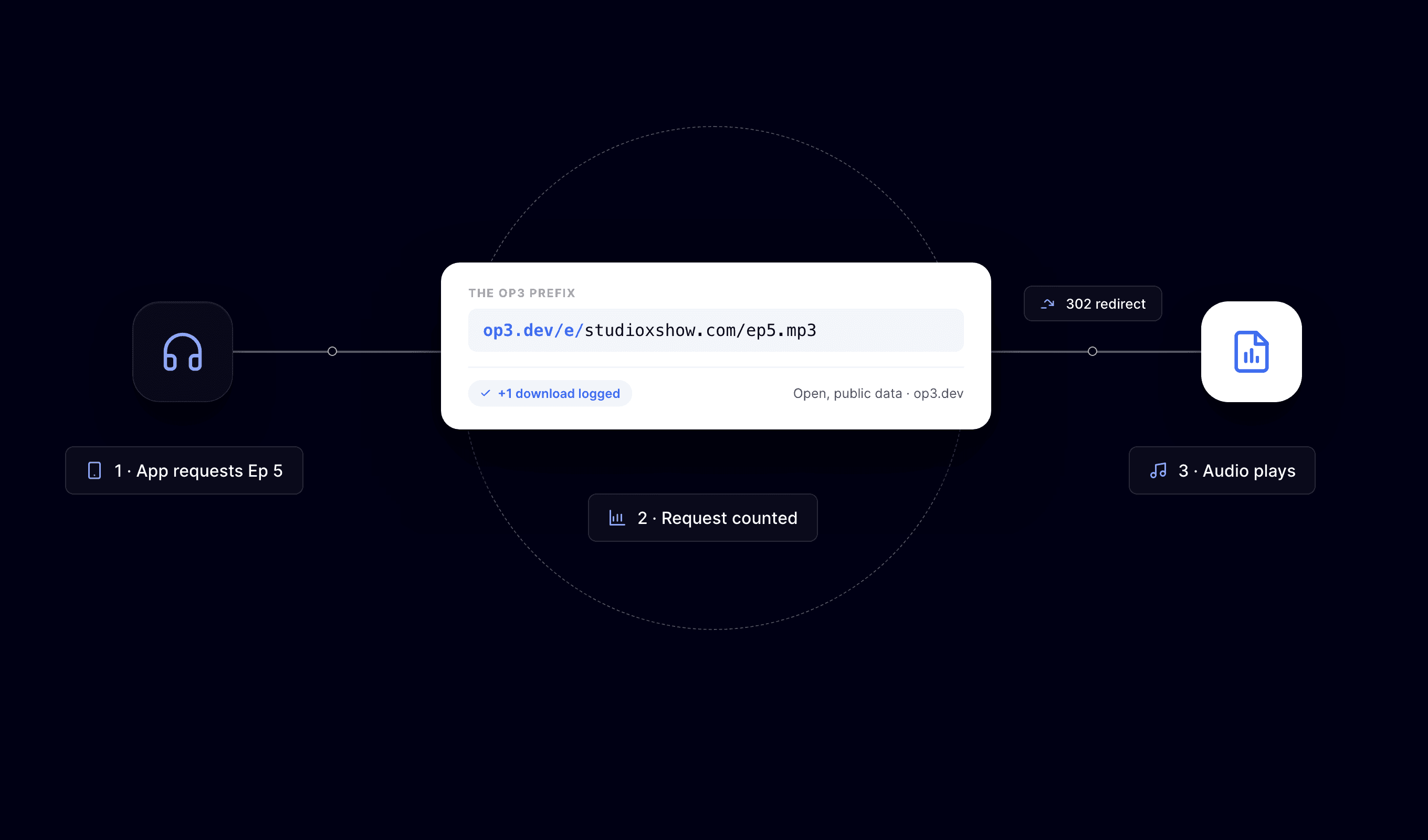
The mechanism is almost disappointingly simple. Your RSS feed lists an audio URL for each episode — the enclosure URL. OP3 works by adding a short prefix to it, so the URL starts with op3.dev/e/ followed by your original file address.
When a listening app requests the episode, the request hits OP3 first, gets logged, and is instantly redirected to your actual audio file. The listener notices nothing — same file, same speed, same everything.
Because every app requests episodes through the same URL, every app gets measured identically. Apple Podcasts, Spotify, Overcast, Pocket Casts — one method, one number.
Why open measurement beats a host dashboard
Host dashboards aren’t evil — they’re just single-source. Each host estimates downloads from its own server logs using its own filtering rules, which is why moving hosts often “changes” your numbers overnight even though your audience didn’t move an inch.
Open measurement fixes the structural problems:
Portability — your OP3 history follows your feed, not your hosting contract
Verifiability — sponsors can check the methodology, which makes your numbers more credible, not less
Consistency — one counting standard across every app instead of a different answer per dashboard
No conflict of interest — the measurer isn’t the company selling you hosting
Setting it up takes minutes
There’s no migration and no downtime. With BuzzyPod the flow is:
Paste your RSS feed URL into BuzzyPod
Add the OP3 prefix at your hosting provider — most hosts have a field for it in settings
Watch downloads start appearing on the dashboard as apps request new episodes
Your listeners are unaffected throughout. Nothing about their apps, subscriptions, or playback changes.
Where BuzzyPod fits
OP3 gives you honest raw data; BuzzyPod turns it into a dashboard you’d actually open with coffee. Total downloads with 7-day and 30-day change, daily charts, an interactive world map down to US metros, app and device breakdowns, and per-episode curves you can compare aligned from launch day.
There are also one-click CSV exports when a sponsor asks for receipts, and unlimited team seats so your producer sees the same numbers you do.
Conclusion
OP3 makes podcast measurement open, portable, and consistent across every listening app — which is how it always should have worked. The prefix takes minutes to add and your listeners will never know it happened.
If you’d like OP3’s honest data with a friendlier face on it, BuzzyPod is the OP3-powered dashboard, $10/month flat with a 14-day free trial.
Related reading
Introduction
If you’ve ever wondered why your podcast host’s download numbers feel like a black box, OP3 podcast analytics are the antidote. OP3 — the Open Podcast Prefix Project — is an open-source service that counts your downloads the same transparent way across every listening app.
Created by John Spurlock and launched in 2022, OP3 has quietly become the trust layer of podcast measurement: privacy-preserving, publicly auditable, and free of any incentive to flatter your numbers.
Here’s how it works, why open measurement matters, and how to actually use it day to day.
Key takeaway
OP3 is an open-source, prefix-based analytics service launched in 2022 by John Spurlock
It adds op3.dev/e/ to your episode URLs, measuring requests before redirecting to the audio
Every listening app is counted the same open way — no silos, no proprietary math
Setup takes minutes at your host; listeners are completely unaffected
BuzzyPod builds a full dashboard — maps, curves, exports — on top of OP3 data
What OP3 actually is
OP3 stands for the Open Podcast Prefix Project. It’s open-source software running as a public service at op3.dev, and its entire job is counting podcast episode requests honestly.
Three things make it unusual in the analytics world:
Open source — anyone can read the code and see exactly how a download gets counted
Privacy-preserving — it measures requests without building listener profiles
Open data — OP3 publishes its data openly instead of locking it behind a login
Compare that with a hosting provider’s dashboard, where the counting logic is proprietary and the company reporting your numbers is the same company you’re paying. Not sinister, but not auditable either.
How the prefix works
The mechanism is almost disappointingly simple. Your RSS feed lists an audio URL for each episode — the enclosure URL. OP3 works by adding a short prefix to it, so the URL starts with op3.dev/e/ followed by your original file address.
When a listening app requests the episode, the request hits OP3 first, gets logged, and is instantly redirected to your actual audio file. The listener notices nothing — same file, same speed, same everything.
Because every app requests episodes through the same URL, every app gets measured identically. Apple Podcasts, Spotify, Overcast, Pocket Casts — one method, one number.
Why open measurement beats a host dashboard
Host dashboards aren’t evil — they’re just single-source. Each host estimates downloads from its own server logs using its own filtering rules, which is why moving hosts often “changes” your numbers overnight even though your audience didn’t move an inch.
Open measurement fixes the structural problems:
Portability — your OP3 history follows your feed, not your hosting contract
Verifiability — sponsors can check the methodology, which makes your numbers more credible, not less
Consistency — one counting standard across every app instead of a different answer per dashboard
No conflict of interest — the measurer isn’t the company selling you hosting
Setting it up takes minutes
There’s no migration and no downtime. With BuzzyPod the flow is:
Paste your RSS feed URL into BuzzyPod
Add the OP3 prefix at your hosting provider — most hosts have a field for it in settings
Watch downloads start appearing on the dashboard as apps request new episodes
Your listeners are unaffected throughout. Nothing about their apps, subscriptions, or playback changes.
Where BuzzyPod fits
OP3 gives you honest raw data; BuzzyPod turns it into a dashboard you’d actually open with coffee. Total downloads with 7-day and 30-day change, daily charts, an interactive world map down to US metros, app and device breakdowns, and per-episode curves you can compare aligned from launch day.
There are also one-click CSV exports when a sponsor asks for receipts, and unlimited team seats so your producer sees the same numbers you do.
Conclusion
OP3 makes podcast measurement open, portable, and consistent across every listening app — which is how it always should have worked. The prefix takes minutes to add and your listeners will never know it happened.
If you’d like OP3’s honest data with a friendlier face on it, BuzzyPod is the OP3-powered dashboard, $10/month flat with a 14-day free trial.
Related reading
Introduction
If you’ve ever wondered why your podcast host’s download numbers feel like a black box, OP3 podcast analytics are the antidote. OP3 — the Open Podcast Prefix Project — is an open-source service that counts your downloads the same transparent way across every listening app.
Created by John Spurlock and launched in 2022, OP3 has quietly become the trust layer of podcast measurement: privacy-preserving, publicly auditable, and free of any incentive to flatter your numbers.
Here’s how it works, why open measurement matters, and how to actually use it day to day.
Key takeaway
OP3 is an open-source, prefix-based analytics service launched in 2022 by John Spurlock
It adds op3.dev/e/ to your episode URLs, measuring requests before redirecting to the audio
Every listening app is counted the same open way — no silos, no proprietary math
Setup takes minutes at your host; listeners are completely unaffected
BuzzyPod builds a full dashboard — maps, curves, exports — on top of OP3 data
What OP3 actually is
OP3 stands for the Open Podcast Prefix Project. It’s open-source software running as a public service at op3.dev, and its entire job is counting podcast episode requests honestly.
Three things make it unusual in the analytics world:
Open source — anyone can read the code and see exactly how a download gets counted
Privacy-preserving — it measures requests without building listener profiles
Open data — OP3 publishes its data openly instead of locking it behind a login
Compare that with a hosting provider’s dashboard, where the counting logic is proprietary and the company reporting your numbers is the same company you’re paying. Not sinister, but not auditable either.
How the prefix works
The mechanism is almost disappointingly simple. Your RSS feed lists an audio URL for each episode — the enclosure URL. OP3 works by adding a short prefix to it, so the URL starts with op3.dev/e/ followed by your original file address.
When a listening app requests the episode, the request hits OP3 first, gets logged, and is instantly redirected to your actual audio file. The listener notices nothing — same file, same speed, same everything.
Because every app requests episodes through the same URL, every app gets measured identically. Apple Podcasts, Spotify, Overcast, Pocket Casts — one method, one number.
Why open measurement beats a host dashboard
Host dashboards aren’t evil — they’re just single-source. Each host estimates downloads from its own server logs using its own filtering rules, which is why moving hosts often “changes” your numbers overnight even though your audience didn’t move an inch.
Open measurement fixes the structural problems:
Portability — your OP3 history follows your feed, not your hosting contract
Verifiability — sponsors can check the methodology, which makes your numbers more credible, not less
Consistency — one counting standard across every app instead of a different answer per dashboard
No conflict of interest — the measurer isn’t the company selling you hosting
Setting it up takes minutes
There’s no migration and no downtime. With BuzzyPod the flow is:
Paste your RSS feed URL into BuzzyPod
Add the OP3 prefix at your hosting provider — most hosts have a field for it in settings
Watch downloads start appearing on the dashboard as apps request new episodes
Your listeners are unaffected throughout. Nothing about their apps, subscriptions, or playback changes.
Where BuzzyPod fits
OP3 gives you honest raw data; BuzzyPod turns it into a dashboard you’d actually open with coffee. Total downloads with 7-day and 30-day change, daily charts, an interactive world map down to US metros, app and device breakdowns, and per-episode curves you can compare aligned from launch day.
There are also one-click CSV exports when a sponsor asks for receipts, and unlimited team seats so your producer sees the same numbers you do.
Conclusion
OP3 makes podcast measurement open, portable, and consistent across every listening app — which is how it always should have worked. The prefix takes minutes to add and your listeners will never know it happened.
If you’d like OP3’s honest data with a friendlier face on it, BuzzyPod is the OP3-powered dashboard, $10/month flat with a 14-day free trial.

