Podcast guest release form: what it is and why every episode needs one

Nathaniel DeSantis
Release Forms & Legal

Introduction
You hit record, have a great conversation, publish the episode — and six months later your guest emails asking you to take it down. This is exactly the situation a podcast guest release form exists to prevent. It’s a short agreement where your guest gives you written permission to record, edit, and publish the conversation.
Most hosts skip it because it feels like paperwork for a friendly chat. Then the show grows, sponsors show up, clips go viral, and suddenly that friendly chat has real value attached to it — and no paper trail.
In this post you’ll learn what a release form actually does, what’s inside one, and how to make signing painless for your guests. Quick note: this is general information, not legal advice — for specifics about your situation, talk to a lawyer.
Key takeaway
A guest release form documents written permission to record, edit, and distribute your guest’s voice and likeness.
It typically covers rights granted, scope of use, editing, compensation, warranties, and governing law.
Verbal agreement is easy to forget and hard to prove; a signed release is neither.
The best time to get it signed is before you record, not after you publish.
E-signed releases are legally recognized in the US under the ESIGN Act and UETA.
What a podcast guest release form actually is
A guest release form is a written agreement between you (the show) and your guest. The guest grants you permission to record their voice — and usually their likeness, if there’s video — and to use, edit, and distribute that recording.
It doesn’t need to be twelve pages of legalese. A good podcast release fits on one or two pages and reads like plain English. The point is clarity: everyone knows what was agreed, and there’s a signature proving it.
Think of it as documented consent. It won’t make disputes impossible, but it makes them dramatically less likely — and much easier to resolve if they happen.
Why every episode with a guest needs one
The awkward truth about podcasting is that most disputes happen long after the recording, when memories have gone fuzzy and circumstances have changed. A guest changes jobs, a topic becomes sensitive, or your show starts making money.
Here’s what a signed release protects you against:
Takedown demands: a guest asking you to remove an episode that’s already earning downloads and sponsor revenue.
Editing complaints: someone claiming you cut the conversation unfairly, when your release granted editing rights.
Repurposing disputes: objections when you turn the interview into clips, quotes, or promo material.
Distribution surprises: a guest who assumed the episode was audio-only objecting when it lands on YouTube.
Monetization friction: a guest asking for a cut once ads or sponsorships arrive.
None of these are hypothetical. They’re the standard failure modes of handshake agreements, and they get more expensive as your show grows.
What’s inside a good release form
Release forms vary, but most solid podcast releases cover the same handful of things:
Grant of rights: permission to record the guest’s voice, likeness, name, and statements.
Scope of use: where and how you can use the recording — the episode itself, clips, promo, any platform.
Editing rights: your ability to cut, trim, and rearrange the conversation.
Compensation: usually a statement that the guest appears voluntarily and isn’t paid.
Warranties: the guest confirms they’re free to say what they say and aren’t breaking other agreements.
Governing law: which US state’s law applies if there’s ever a dispute.
Signatures: both parties, with dates.
If a clause in your form doesn’t map to one of these, ask yourself why it’s there. Bloat makes guests nervous; clarity makes them sign.
When to send it (and how to make it painless)
Send the release before you record — ideally alongside the calendar invite. Guests are most agreeable at booking time, when appearing on your show is a fresh, exciting idea.
Asking after publication flips the power dynamic. Now you’re the one asking for a favor, and the guest has all the leverage.
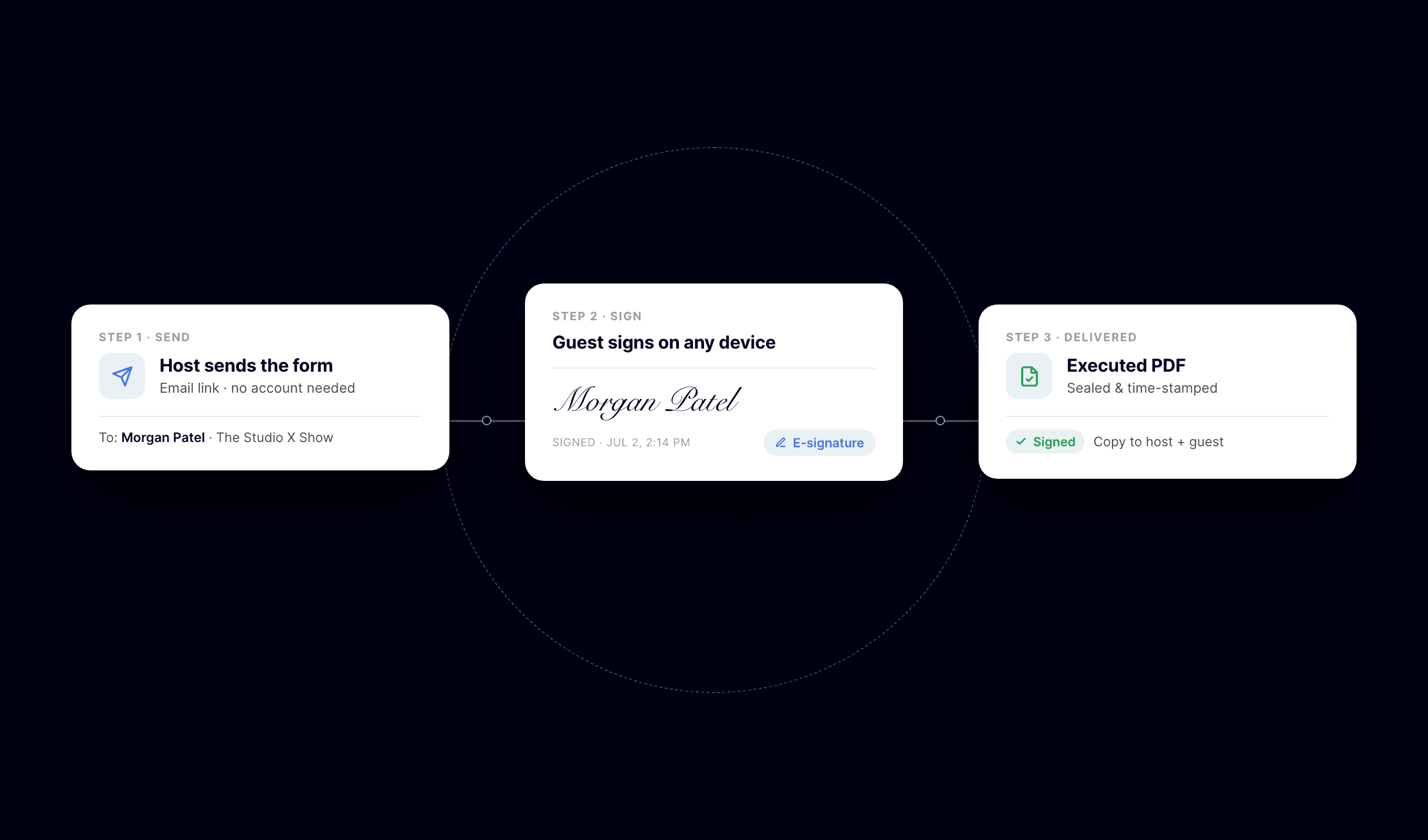
The other half is friction. If signing requires printing, scanning, or creating an account with some enterprise e-signature tool, a chunk of guests will simply stall. A link they can tap on their phone and sign in under a minute gets signed the same day.
Paper vs. e-signature
E-signatures have been legally recognized in the US since the ESIGN Act of 2000, and nearly every state has adopted UETA. A typed or drawn signature collected electronically carries legal weight for agreements like this.
For proof, a good e-sign flow actually beats paper: it can log when the form was created, sent, viewed, and signed, with timestamps. Try getting that from a scanned PDF someone emailed back.
Conclusion
A guest release form is the cheapest insurance in podcasting: one page, one signature, and years of published episodes protected. Make it part of your booking routine and you’ll never think about it again.
If you’d rather not hunt for templates or pay per-envelope fees, BuzzyPod includes a ready-made guest release with e-signing built in — guests sign from a link on any device, and it’s $10/month flat with a 14-day free trial.
Related reading
Introduction
You hit record, have a great conversation, publish the episode — and six months later your guest emails asking you to take it down. This is exactly the situation a podcast guest release form exists to prevent. It’s a short agreement where your guest gives you written permission to record, edit, and publish the conversation.
Most hosts skip it because it feels like paperwork for a friendly chat. Then the show grows, sponsors show up, clips go viral, and suddenly that friendly chat has real value attached to it — and no paper trail.
In this post you’ll learn what a release form actually does, what’s inside one, and how to make signing painless for your guests. Quick note: this is general information, not legal advice — for specifics about your situation, talk to a lawyer.
Key takeaway
A guest release form documents written permission to record, edit, and distribute your guest’s voice and likeness.
It typically covers rights granted, scope of use, editing, compensation, warranties, and governing law.
Verbal agreement is easy to forget and hard to prove; a signed release is neither.
The best time to get it signed is before you record, not after you publish.
E-signed releases are legally recognized in the US under the ESIGN Act and UETA.
What a podcast guest release form actually is
A guest release form is a written agreement between you (the show) and your guest. The guest grants you permission to record their voice — and usually their likeness, if there’s video — and to use, edit, and distribute that recording.
It doesn’t need to be twelve pages of legalese. A good podcast release fits on one or two pages and reads like plain English. The point is clarity: everyone knows what was agreed, and there’s a signature proving it.
Think of it as documented consent. It won’t make disputes impossible, but it makes them dramatically less likely — and much easier to resolve if they happen.
Why every episode with a guest needs one
The awkward truth about podcasting is that most disputes happen long after the recording, when memories have gone fuzzy and circumstances have changed. A guest changes jobs, a topic becomes sensitive, or your show starts making money.
Here’s what a signed release protects you against:
Takedown demands: a guest asking you to remove an episode that’s already earning downloads and sponsor revenue.
Editing complaints: someone claiming you cut the conversation unfairly, when your release granted editing rights.
Repurposing disputes: objections when you turn the interview into clips, quotes, or promo material.
Distribution surprises: a guest who assumed the episode was audio-only objecting when it lands on YouTube.
Monetization friction: a guest asking for a cut once ads or sponsorships arrive.
None of these are hypothetical. They’re the standard failure modes of handshake agreements, and they get more expensive as your show grows.
What’s inside a good release form
Release forms vary, but most solid podcast releases cover the same handful of things:
Grant of rights: permission to record the guest’s voice, likeness, name, and statements.
Scope of use: where and how you can use the recording — the episode itself, clips, promo, any platform.
Editing rights: your ability to cut, trim, and rearrange the conversation.
Compensation: usually a statement that the guest appears voluntarily and isn’t paid.
Warranties: the guest confirms they’re free to say what they say and aren’t breaking other agreements.
Governing law: which US state’s law applies if there’s ever a dispute.
Signatures: both parties, with dates.
If a clause in your form doesn’t map to one of these, ask yourself why it’s there. Bloat makes guests nervous; clarity makes them sign.
When to send it (and how to make it painless)
Send the release before you record — ideally alongside the calendar invite. Guests are most agreeable at booking time, when appearing on your show is a fresh, exciting idea.
Asking after publication flips the power dynamic. Now you’re the one asking for a favor, and the guest has all the leverage.
The other half is friction. If signing requires printing, scanning, or creating an account with some enterprise e-signature tool, a chunk of guests will simply stall. A link they can tap on their phone and sign in under a minute gets signed the same day.
Paper vs. e-signature
E-signatures have been legally recognized in the US since the ESIGN Act of 2000, and nearly every state has adopted UETA. A typed or drawn signature collected electronically carries legal weight for agreements like this.
For proof, a good e-sign flow actually beats paper: it can log when the form was created, sent, viewed, and signed, with timestamps. Try getting that from a scanned PDF someone emailed back.
Conclusion
A guest release form is the cheapest insurance in podcasting: one page, one signature, and years of published episodes protected. Make it part of your booking routine and you’ll never think about it again.
If you’d rather not hunt for templates or pay per-envelope fees, BuzzyPod includes a ready-made guest release with e-signing built in — guests sign from a link on any device, and it’s $10/month flat with a 14-day free trial.
Related reading
Introduction
You hit record, have a great conversation, publish the episode — and six months later your guest emails asking you to take it down. This is exactly the situation a podcast guest release form exists to prevent. It’s a short agreement where your guest gives you written permission to record, edit, and publish the conversation.
Most hosts skip it because it feels like paperwork for a friendly chat. Then the show grows, sponsors show up, clips go viral, and suddenly that friendly chat has real value attached to it — and no paper trail.
In this post you’ll learn what a release form actually does, what’s inside one, and how to make signing painless for your guests. Quick note: this is general information, not legal advice — for specifics about your situation, talk to a lawyer.
Key takeaway
A guest release form documents written permission to record, edit, and distribute your guest’s voice and likeness.
It typically covers rights granted, scope of use, editing, compensation, warranties, and governing law.
Verbal agreement is easy to forget and hard to prove; a signed release is neither.
The best time to get it signed is before you record, not after you publish.
E-signed releases are legally recognized in the US under the ESIGN Act and UETA.
What a podcast guest release form actually is
A guest release form is a written agreement between you (the show) and your guest. The guest grants you permission to record their voice — and usually their likeness, if there’s video — and to use, edit, and distribute that recording.
It doesn’t need to be twelve pages of legalese. A good podcast release fits on one or two pages and reads like plain English. The point is clarity: everyone knows what was agreed, and there’s a signature proving it.
Think of it as documented consent. It won’t make disputes impossible, but it makes them dramatically less likely — and much easier to resolve if they happen.
Why every episode with a guest needs one
The awkward truth about podcasting is that most disputes happen long after the recording, when memories have gone fuzzy and circumstances have changed. A guest changes jobs, a topic becomes sensitive, or your show starts making money.
Here’s what a signed release protects you against:
Takedown demands: a guest asking you to remove an episode that’s already earning downloads and sponsor revenue.
Editing complaints: someone claiming you cut the conversation unfairly, when your release granted editing rights.
Repurposing disputes: objections when you turn the interview into clips, quotes, or promo material.
Distribution surprises: a guest who assumed the episode was audio-only objecting when it lands on YouTube.
Monetization friction: a guest asking for a cut once ads or sponsorships arrive.
None of these are hypothetical. They’re the standard failure modes of handshake agreements, and they get more expensive as your show grows.
What’s inside a good release form
Release forms vary, but most solid podcast releases cover the same handful of things:
Grant of rights: permission to record the guest’s voice, likeness, name, and statements.
Scope of use: where and how you can use the recording — the episode itself, clips, promo, any platform.
Editing rights: your ability to cut, trim, and rearrange the conversation.
Compensation: usually a statement that the guest appears voluntarily and isn’t paid.
Warranties: the guest confirms they’re free to say what they say and aren’t breaking other agreements.
Governing law: which US state’s law applies if there’s ever a dispute.
Signatures: both parties, with dates.
If a clause in your form doesn’t map to one of these, ask yourself why it’s there. Bloat makes guests nervous; clarity makes them sign.
When to send it (and how to make it painless)
Send the release before you record — ideally alongside the calendar invite. Guests are most agreeable at booking time, when appearing on your show is a fresh, exciting idea.
Asking after publication flips the power dynamic. Now you’re the one asking for a favor, and the guest has all the leverage.
The other half is friction. If signing requires printing, scanning, or creating an account with some enterprise e-signature tool, a chunk of guests will simply stall. A link they can tap on their phone and sign in under a minute gets signed the same day.
Paper vs. e-signature
E-signatures have been legally recognized in the US since the ESIGN Act of 2000, and nearly every state has adopted UETA. A typed or drawn signature collected electronically carries legal weight for agreements like this.
For proof, a good e-sign flow actually beats paper: it can log when the form was created, sent, viewed, and signed, with timestamps. Try getting that from a scanned PDF someone emailed back.
Conclusion
A guest release form is the cheapest insurance in podcasting: one page, one signature, and years of published episodes protected. Make it part of your booking routine and you’ll never think about it again.
If you’d rather not hunt for templates or pay per-envelope fees, BuzzyPod includes a ready-made guest release with e-signing built in — guests sign from a link on any device, and it’s $10/month flat with a 14-day free trial.

