What to include in a podcast guest release form: a clause-by-clause breakdown

Nathaniel DeSantis
Release Forms & Legal

Introduction
A guest release only protects you if it says the right things. Knowing what to include in a podcast release form — clause by clause — is the difference between a document that covers your actual workflow and one that just looks official.
The good news: a complete podcast release needs only about seven clauses, and each one has a plain-English job you can explain to any guest in a sentence.
Let’s walk through them one at a time. Standard disclaimer up front: this is general information, not legal advice — for your specific situation, talk to a lawyer.
Key takeaway
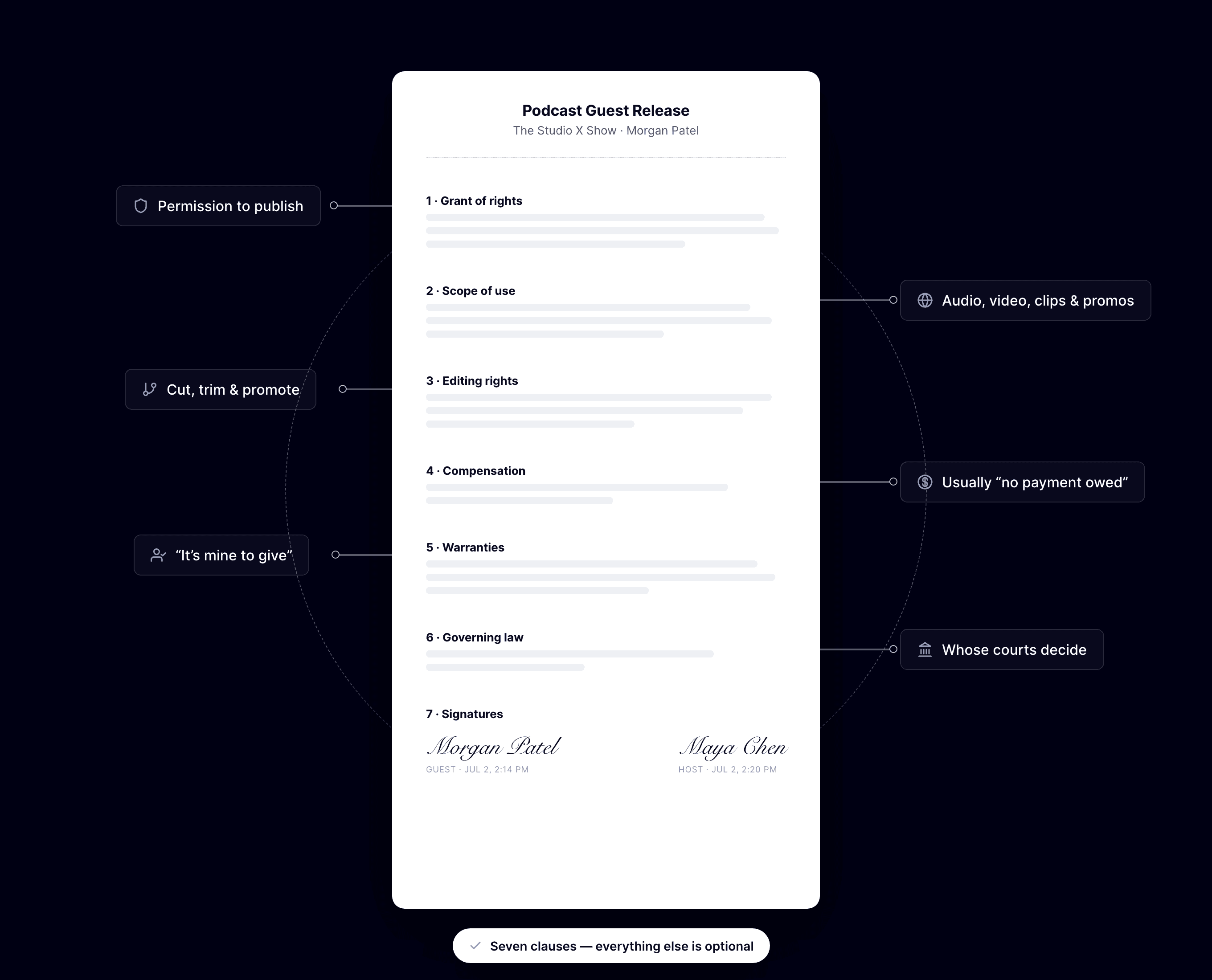
Seven clauses cover a podcast release: grant of rights, scope of use, editing, compensation, warranties, governing law, and signatures.
The grant of rights should cover voice, likeness, name, and statements — not just “the recording.”
Scope of use must include clips, promo material, and any platform, or your normal workflow exceeds the release.
Editing rights are the most commonly missing clause in generic templates.
Governing law should name a specific US state; signatures need both parties and dates.
Clause 1: Grant of rights
This is the engine of the document. The guest grants you permission to record and use their voice, likeness, name, and statements. Note the list — a grant covering only “the recording” gets murky the moment you use the guest’s name and face in promotion.
The grant is typically irrevocable and perpetual for the content created, so a change of heart later doesn’t unravel your published catalog. Plain-English version for your guest: “you’re letting us record you and use the recording.”
Clause 2: Scope of use
Scope answers “use it how, and where?” This clause should match how podcasts actually get distributed and repurposed:
The full episode, on any podcast platform or app.
Video versions, including YouTube.
Clips, excerpts, and audiograms for social media.
Transcripts and quotes.
Promotional and marketing material for the show.
If your release covers only “the podcast episode,” then technically every Instagram clip is off-script. Write the scope to match reality.
Clause 3: Editing rights
The most commonly missing clause in borrowed templates. You need explicit permission to edit: cut, condense, rearrange, and excerpt the conversation.
Without it, a guest unhappy with your cut has an argument that you exceeded their consent. With it, editorial judgment stays where it belongs — with you. Most releases also make clear you’re not obligated to publish the episode at all.
Clauses 4 and 5: Compensation and warranties
The compensation clause usually says there isn’t any: the guest appears voluntarily and receives no payment. Stating this explicitly prevents the later “the episode made money, where’s my share?” conversation — the terms were clear from day one.
Warranties are the guest’s side of the promises. Typically the guest confirms:
They’re legally able to enter the agreement.
Their participation doesn’t violate other obligations, like an employer’s policies or an NDA.
The stories and material they share are theirs to share.
This matters because guests sometimes say things their employer or a past contract wouldn’t love. The warranty puts responsibility for that with the person who made the statement.
Clauses 6 and 7: Governing law and signatures
Governing law names which US state’s law applies to the agreement. It feels like boilerplate until there’s a disagreement — then it decides whose rules referee. Pick a specific state, usually where you or your show’s business is based.
Signatures make it all real. You need:
The guest’s signature and the date.
A signature from the show’s side — a host or representative — and the date.
Both parties’ names printed clearly, so there’s no ambiguity about who signed.
E-signatures fully count here: US law has recognized them since the ESIGN Act of 2000, and a typed signature collected through a proper e-sign flow — with an audit trail — is generally easier to attribute than a scrawl on paper.
What you can leave out
Just as important as the seven keepers: resist padding. Exclusivity clauses, aggressive indemnification, and payment machinery copied from other industries add intimidation without adding protection for a typical interview show. A release a guest can read and understand in two minutes is a release that gets signed.
Conclusion
Seven clauses, one or two pages, plain language: grant of rights, scope, editing, compensation, warranties, governing law, signatures. Get those right and your release covers the way podcasts are actually made and shared.
If you’d rather not assemble it yourself, BuzzyPod’s built-in guest release already covers all of this — you just fill in the podcast name, guest details, and governing state, then send it for e-signature. $10/month, 14-day free trial.
Related reading
Introduction
A guest release only protects you if it says the right things. Knowing what to include in a podcast release form — clause by clause — is the difference between a document that covers your actual workflow and one that just looks official.
The good news: a complete podcast release needs only about seven clauses, and each one has a plain-English job you can explain to any guest in a sentence.
Let’s walk through them one at a time. Standard disclaimer up front: this is general information, not legal advice — for your specific situation, talk to a lawyer.
Key takeaway
Seven clauses cover a podcast release: grant of rights, scope of use, editing, compensation, warranties, governing law, and signatures.
The grant of rights should cover voice, likeness, name, and statements — not just “the recording.”
Scope of use must include clips, promo material, and any platform, or your normal workflow exceeds the release.
Editing rights are the most commonly missing clause in generic templates.
Governing law should name a specific US state; signatures need both parties and dates.
Clause 1: Grant of rights
This is the engine of the document. The guest grants you permission to record and use their voice, likeness, name, and statements. Note the list — a grant covering only “the recording” gets murky the moment you use the guest’s name and face in promotion.
The grant is typically irrevocable and perpetual for the content created, so a change of heart later doesn’t unravel your published catalog. Plain-English version for your guest: “you’re letting us record you and use the recording.”
Clause 2: Scope of use
Scope answers “use it how, and where?” This clause should match how podcasts actually get distributed and repurposed:
The full episode, on any podcast platform or app.
Video versions, including YouTube.
Clips, excerpts, and audiograms for social media.
Transcripts and quotes.
Promotional and marketing material for the show.
If your release covers only “the podcast episode,” then technically every Instagram clip is off-script. Write the scope to match reality.
Clause 3: Editing rights
The most commonly missing clause in borrowed templates. You need explicit permission to edit: cut, condense, rearrange, and excerpt the conversation.
Without it, a guest unhappy with your cut has an argument that you exceeded their consent. With it, editorial judgment stays where it belongs — with you. Most releases also make clear you’re not obligated to publish the episode at all.
Clauses 4 and 5: Compensation and warranties
The compensation clause usually says there isn’t any: the guest appears voluntarily and receives no payment. Stating this explicitly prevents the later “the episode made money, where’s my share?” conversation — the terms were clear from day one.
Warranties are the guest’s side of the promises. Typically the guest confirms:
They’re legally able to enter the agreement.
Their participation doesn’t violate other obligations, like an employer’s policies or an NDA.
The stories and material they share are theirs to share.
This matters because guests sometimes say things their employer or a past contract wouldn’t love. The warranty puts responsibility for that with the person who made the statement.
Clauses 6 and 7: Governing law and signatures
Governing law names which US state’s law applies to the agreement. It feels like boilerplate until there’s a disagreement — then it decides whose rules referee. Pick a specific state, usually where you or your show’s business is based.
Signatures make it all real. You need:
The guest’s signature and the date.
A signature from the show’s side — a host or representative — and the date.
Both parties’ names printed clearly, so there’s no ambiguity about who signed.
E-signatures fully count here: US law has recognized them since the ESIGN Act of 2000, and a typed signature collected through a proper e-sign flow — with an audit trail — is generally easier to attribute than a scrawl on paper.
What you can leave out
Just as important as the seven keepers: resist padding. Exclusivity clauses, aggressive indemnification, and payment machinery copied from other industries add intimidation without adding protection for a typical interview show. A release a guest can read and understand in two minutes is a release that gets signed.
Conclusion
Seven clauses, one or two pages, plain language: grant of rights, scope, editing, compensation, warranties, governing law, signatures. Get those right and your release covers the way podcasts are actually made and shared.
If you’d rather not assemble it yourself, BuzzyPod’s built-in guest release already covers all of this — you just fill in the podcast name, guest details, and governing state, then send it for e-signature. $10/month, 14-day free trial.
Related reading
Introduction
A guest release only protects you if it says the right things. Knowing what to include in a podcast release form — clause by clause — is the difference between a document that covers your actual workflow and one that just looks official.
The good news: a complete podcast release needs only about seven clauses, and each one has a plain-English job you can explain to any guest in a sentence.
Let’s walk through them one at a time. Standard disclaimer up front: this is general information, not legal advice — for your specific situation, talk to a lawyer.
Key takeaway
Seven clauses cover a podcast release: grant of rights, scope of use, editing, compensation, warranties, governing law, and signatures.
The grant of rights should cover voice, likeness, name, and statements — not just “the recording.”
Scope of use must include clips, promo material, and any platform, or your normal workflow exceeds the release.
Editing rights are the most commonly missing clause in generic templates.
Governing law should name a specific US state; signatures need both parties and dates.
Clause 1: Grant of rights
This is the engine of the document. The guest grants you permission to record and use their voice, likeness, name, and statements. Note the list — a grant covering only “the recording” gets murky the moment you use the guest’s name and face in promotion.
The grant is typically irrevocable and perpetual for the content created, so a change of heart later doesn’t unravel your published catalog. Plain-English version for your guest: “you’re letting us record you and use the recording.”
Clause 2: Scope of use
Scope answers “use it how, and where?” This clause should match how podcasts actually get distributed and repurposed:
The full episode, on any podcast platform or app.
Video versions, including YouTube.
Clips, excerpts, and audiograms for social media.
Transcripts and quotes.
Promotional and marketing material for the show.
If your release covers only “the podcast episode,” then technically every Instagram clip is off-script. Write the scope to match reality.
Clause 3: Editing rights
The most commonly missing clause in borrowed templates. You need explicit permission to edit: cut, condense, rearrange, and excerpt the conversation.
Without it, a guest unhappy with your cut has an argument that you exceeded their consent. With it, editorial judgment stays where it belongs — with you. Most releases also make clear you’re not obligated to publish the episode at all.
Clauses 4 and 5: Compensation and warranties
The compensation clause usually says there isn’t any: the guest appears voluntarily and receives no payment. Stating this explicitly prevents the later “the episode made money, where’s my share?” conversation — the terms were clear from day one.
Warranties are the guest’s side of the promises. Typically the guest confirms:
They’re legally able to enter the agreement.
Their participation doesn’t violate other obligations, like an employer’s policies or an NDA.
The stories and material they share are theirs to share.
This matters because guests sometimes say things their employer or a past contract wouldn’t love. The warranty puts responsibility for that with the person who made the statement.
Clauses 6 and 7: Governing law and signatures
Governing law names which US state’s law applies to the agreement. It feels like boilerplate until there’s a disagreement — then it decides whose rules referee. Pick a specific state, usually where you or your show’s business is based.
Signatures make it all real. You need:
The guest’s signature and the date.
A signature from the show’s side — a host or representative — and the date.
Both parties’ names printed clearly, so there’s no ambiguity about who signed.
E-signatures fully count here: US law has recognized them since the ESIGN Act of 2000, and a typed signature collected through a proper e-sign flow — with an audit trail — is generally easier to attribute than a scrawl on paper.
What you can leave out
Just as important as the seven keepers: resist padding. Exclusivity clauses, aggressive indemnification, and payment machinery copied from other industries add intimidation without adding protection for a typical interview show. A release a guest can read and understand in two minutes is a release that gets signed.
Conclusion
Seven clauses, one or two pages, plain language: grant of rights, scope, editing, compensation, warranties, governing law, signatures. Get those right and your release covers the way podcasts are actually made and shared.
If you’d rather not assemble it yourself, BuzzyPod’s built-in guest release already covers all of this — you just fill in the podcast name, guest details, and governing state, then send it for e-signature. $10/month, 14-day free trial.

