Podcast interview release forms for video and YouTube: what changes

Nathaniel DeSantis
Release Forms & Legal

Introduction
Adding cameras to your show changes more than your lighting budget. A video podcast release form has to cover things an audio-only release never worried about: your guest’s face, on YouTube, in vertical clips, and — most sensitively — in thumbnails engineered to get clicks.
Voice and likeness are different things, legally and emotionally. Guests who’d never think twice about their voice in a feed can feel very differently about a freeze-frame of their face next to a spicy caption on a Short.
Here’s what changes when video enters the picture, and how to make sure your release keeps up. As always: general information, not legal advice — talk to a lawyer about your specific situation.
Key takeaway
Video adds likeness — the guest’s face and image — to what your release must cover.
Clips, Shorts, and Reels are derivative works; the release should cover excerpts, not just the full episode.
Thumbnails deserve explicit coverage — they’re marketing images built from your guest’s face.
Scope should be platform-agnostic: any platform, any format, existing or future.
An audio-era release doesn’t automatically stretch to cover your new video workflow.
Voice vs. likeness: why video raises the stakes
An audio release fundamentally covers a voice and the words it says. Video adds likeness: the guest’s face, expressions, and image. Likeness is more personal, more recognizable, and more sensitive — people have stronger feelings about how their face is used than their voice.
Practically, that means a release written for an audio show — “permission to record and distribute the audio recording” — may simply not cover what your video workflow does. If your form predates your cameras, it’s due for an upgrade.
Clips, Shorts, and Reels: the derivative-content problem
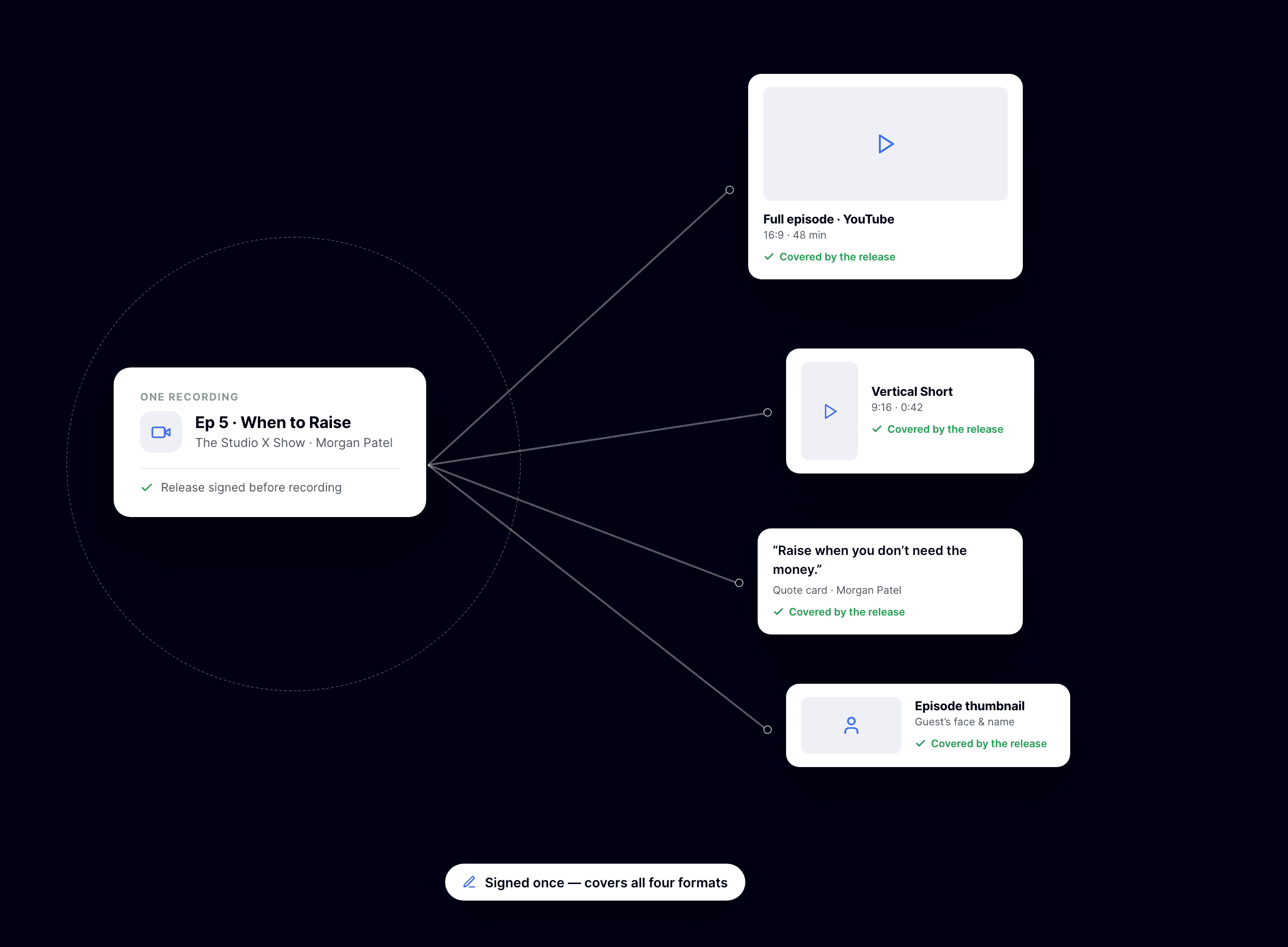
Modern video podcasting is a clip factory. One recording becomes a full episode, several YouTube clips, vertical Shorts and Reels, and quote cards. Each of those is a derivative work — a new thing made from the original recording.
Your release should say so explicitly. Look for language covering:
Excerpts and clips of any length, in any aspect ratio.
Edited and recontextualized versions — captions, zooms, reaction framing.
Distribution across any platform, current or future.
Promotional use of those clips to market the show.
The reason to be explicit: clips are where guests most often feel misrepresented. Sixty seconds pulled from a nuanced hour can land very differently, and a guest upset about a clip will look hard at what they actually agreed to.
Thumbnails: the clause everyone forgets
Thumbnails are marketing images built from your guest’s face, often with an exaggerated expression, chosen specifically to drive clicks. That’s promotional use of likeness — a distinct thing from the episode itself.
A good video-era release covers using the guest’s image and name in promotional materials, which includes thumbnails, channel art, and social posts. If your release only covers “the recording,” a thumbnail — a still image you created — sits in gray territory.
Side note on relationships: even with full rights, a heads-up before publishing an unflattering thumbnail keeps guests coming back. The release protects the show; courtesy protects the friendship.
Platform language that doesn’t age
Don’t enumerate platforms by name and stop there — platforms come and go. The durable pattern is “any and all media and platforms, now known or later developed.” That way your release survives the next app cycle without a re-sign.
A quick checklist for a video-ready release:
Grant of rights covering voice, likeness, name, and statements.
Scope including full episodes, clips, and excerpts in any format.
Explicit editing and derivative-work rights.
Promotional use of the guest’s image, including thumbnails.
Platform-agnostic distribution language.
The usual foundation: compensation, warranties, governing law, signatures.
One release, signed once
The efficient move is a single comprehensive release signed before recording — not separate permissions for the episode, the clips, and the thumbnail. Guests sign one clear document at booking time; you repurpose freely afterward without a fresh ask per asset.
This is also kinder to guests. Nobody wants four permission emails for one appearance.
Conclusion
Video turns one recording into a dozen assets featuring your guest’s face. Make sure the release signed on day one covers likeness, clips, and promotional images — so your best-performing Short never becomes your most awkward email.
BuzzyPod’s built-in guest release is written for how modern shows publish, and guests sign it from a link on any device — no account needed. It’s part of BuzzyPod at $10/month flat, with a 14-day free trial.
Related reading
Introduction
Adding cameras to your show changes more than your lighting budget. A video podcast release form has to cover things an audio-only release never worried about: your guest’s face, on YouTube, in vertical clips, and — most sensitively — in thumbnails engineered to get clicks.
Voice and likeness are different things, legally and emotionally. Guests who’d never think twice about their voice in a feed can feel very differently about a freeze-frame of their face next to a spicy caption on a Short.
Here’s what changes when video enters the picture, and how to make sure your release keeps up. As always: general information, not legal advice — talk to a lawyer about your specific situation.
Key takeaway
Video adds likeness — the guest’s face and image — to what your release must cover.
Clips, Shorts, and Reels are derivative works; the release should cover excerpts, not just the full episode.
Thumbnails deserve explicit coverage — they’re marketing images built from your guest’s face.
Scope should be platform-agnostic: any platform, any format, existing or future.
An audio-era release doesn’t automatically stretch to cover your new video workflow.
Voice vs. likeness: why video raises the stakes
An audio release fundamentally covers a voice and the words it says. Video adds likeness: the guest’s face, expressions, and image. Likeness is more personal, more recognizable, and more sensitive — people have stronger feelings about how their face is used than their voice.
Practically, that means a release written for an audio show — “permission to record and distribute the audio recording” — may simply not cover what your video workflow does. If your form predates your cameras, it’s due for an upgrade.
Clips, Shorts, and Reels: the derivative-content problem
Modern video podcasting is a clip factory. One recording becomes a full episode, several YouTube clips, vertical Shorts and Reels, and quote cards. Each of those is a derivative work — a new thing made from the original recording.
Your release should say so explicitly. Look for language covering:
Excerpts and clips of any length, in any aspect ratio.
Edited and recontextualized versions — captions, zooms, reaction framing.
Distribution across any platform, current or future.
Promotional use of those clips to market the show.
The reason to be explicit: clips are where guests most often feel misrepresented. Sixty seconds pulled from a nuanced hour can land very differently, and a guest upset about a clip will look hard at what they actually agreed to.
Thumbnails: the clause everyone forgets
Thumbnails are marketing images built from your guest’s face, often with an exaggerated expression, chosen specifically to drive clicks. That’s promotional use of likeness — a distinct thing from the episode itself.
A good video-era release covers using the guest’s image and name in promotional materials, which includes thumbnails, channel art, and social posts. If your release only covers “the recording,” a thumbnail — a still image you created — sits in gray territory.
Side note on relationships: even with full rights, a heads-up before publishing an unflattering thumbnail keeps guests coming back. The release protects the show; courtesy protects the friendship.
Platform language that doesn’t age
Don’t enumerate platforms by name and stop there — platforms come and go. The durable pattern is “any and all media and platforms, now known or later developed.” That way your release survives the next app cycle without a re-sign.
A quick checklist for a video-ready release:
Grant of rights covering voice, likeness, name, and statements.
Scope including full episodes, clips, and excerpts in any format.
Explicit editing and derivative-work rights.
Promotional use of the guest’s image, including thumbnails.
Platform-agnostic distribution language.
The usual foundation: compensation, warranties, governing law, signatures.
One release, signed once
The efficient move is a single comprehensive release signed before recording — not separate permissions for the episode, the clips, and the thumbnail. Guests sign one clear document at booking time; you repurpose freely afterward without a fresh ask per asset.
This is also kinder to guests. Nobody wants four permission emails for one appearance.
Conclusion
Video turns one recording into a dozen assets featuring your guest’s face. Make sure the release signed on day one covers likeness, clips, and promotional images — so your best-performing Short never becomes your most awkward email.
BuzzyPod’s built-in guest release is written for how modern shows publish, and guests sign it from a link on any device — no account needed. It’s part of BuzzyPod at $10/month flat, with a 14-day free trial.
Related reading
Introduction
Adding cameras to your show changes more than your lighting budget. A video podcast release form has to cover things an audio-only release never worried about: your guest’s face, on YouTube, in vertical clips, and — most sensitively — in thumbnails engineered to get clicks.
Voice and likeness are different things, legally and emotionally. Guests who’d never think twice about their voice in a feed can feel very differently about a freeze-frame of their face next to a spicy caption on a Short.
Here’s what changes when video enters the picture, and how to make sure your release keeps up. As always: general information, not legal advice — talk to a lawyer about your specific situation.
Key takeaway
Video adds likeness — the guest’s face and image — to what your release must cover.
Clips, Shorts, and Reels are derivative works; the release should cover excerpts, not just the full episode.
Thumbnails deserve explicit coverage — they’re marketing images built from your guest’s face.
Scope should be platform-agnostic: any platform, any format, existing or future.
An audio-era release doesn’t automatically stretch to cover your new video workflow.
Voice vs. likeness: why video raises the stakes
An audio release fundamentally covers a voice and the words it says. Video adds likeness: the guest’s face, expressions, and image. Likeness is more personal, more recognizable, and more sensitive — people have stronger feelings about how their face is used than their voice.
Practically, that means a release written for an audio show — “permission to record and distribute the audio recording” — may simply not cover what your video workflow does. If your form predates your cameras, it’s due for an upgrade.
Clips, Shorts, and Reels: the derivative-content problem
Modern video podcasting is a clip factory. One recording becomes a full episode, several YouTube clips, vertical Shorts and Reels, and quote cards. Each of those is a derivative work — a new thing made from the original recording.
Your release should say so explicitly. Look for language covering:
Excerpts and clips of any length, in any aspect ratio.
Edited and recontextualized versions — captions, zooms, reaction framing.
Distribution across any platform, current or future.
Promotional use of those clips to market the show.
The reason to be explicit: clips are where guests most often feel misrepresented. Sixty seconds pulled from a nuanced hour can land very differently, and a guest upset about a clip will look hard at what they actually agreed to.
Thumbnails: the clause everyone forgets
Thumbnails are marketing images built from your guest’s face, often with an exaggerated expression, chosen specifically to drive clicks. That’s promotional use of likeness — a distinct thing from the episode itself.
A good video-era release covers using the guest’s image and name in promotional materials, which includes thumbnails, channel art, and social posts. If your release only covers “the recording,” a thumbnail — a still image you created — sits in gray territory.
Side note on relationships: even with full rights, a heads-up before publishing an unflattering thumbnail keeps guests coming back. The release protects the show; courtesy protects the friendship.
Platform language that doesn’t age
Don’t enumerate platforms by name and stop there — platforms come and go. The durable pattern is “any and all media and platforms, now known or later developed.” That way your release survives the next app cycle without a re-sign.
A quick checklist for a video-ready release:
Grant of rights covering voice, likeness, name, and statements.
Scope including full episodes, clips, and excerpts in any format.
Explicit editing and derivative-work rights.
Promotional use of the guest’s image, including thumbnails.
Platform-agnostic distribution language.
The usual foundation: compensation, warranties, governing law, signatures.
One release, signed once
The efficient move is a single comprehensive release signed before recording — not separate permissions for the episode, the clips, and the thumbnail. Guests sign one clear document at booking time; you repurpose freely afterward without a fresh ask per asset.
This is also kinder to guests. Nobody wants four permission emails for one appearance.
Conclusion
Video turns one recording into a dozen assets featuring your guest’s face. Make sure the release signed on day one covers likeness, clips, and promotional images — so your best-performing Short never becomes your most awkward email.
BuzzyPod’s built-in guest release is written for how modern shows publish, and guests sign it from a link on any device — no account needed. It’s part of BuzzyPod at $10/month flat, with a 14-day free trial.

