Free podcast release form template: what to include (and what to skip)

Nathaniel DeSantis
Release Forms & Legal

Introduction
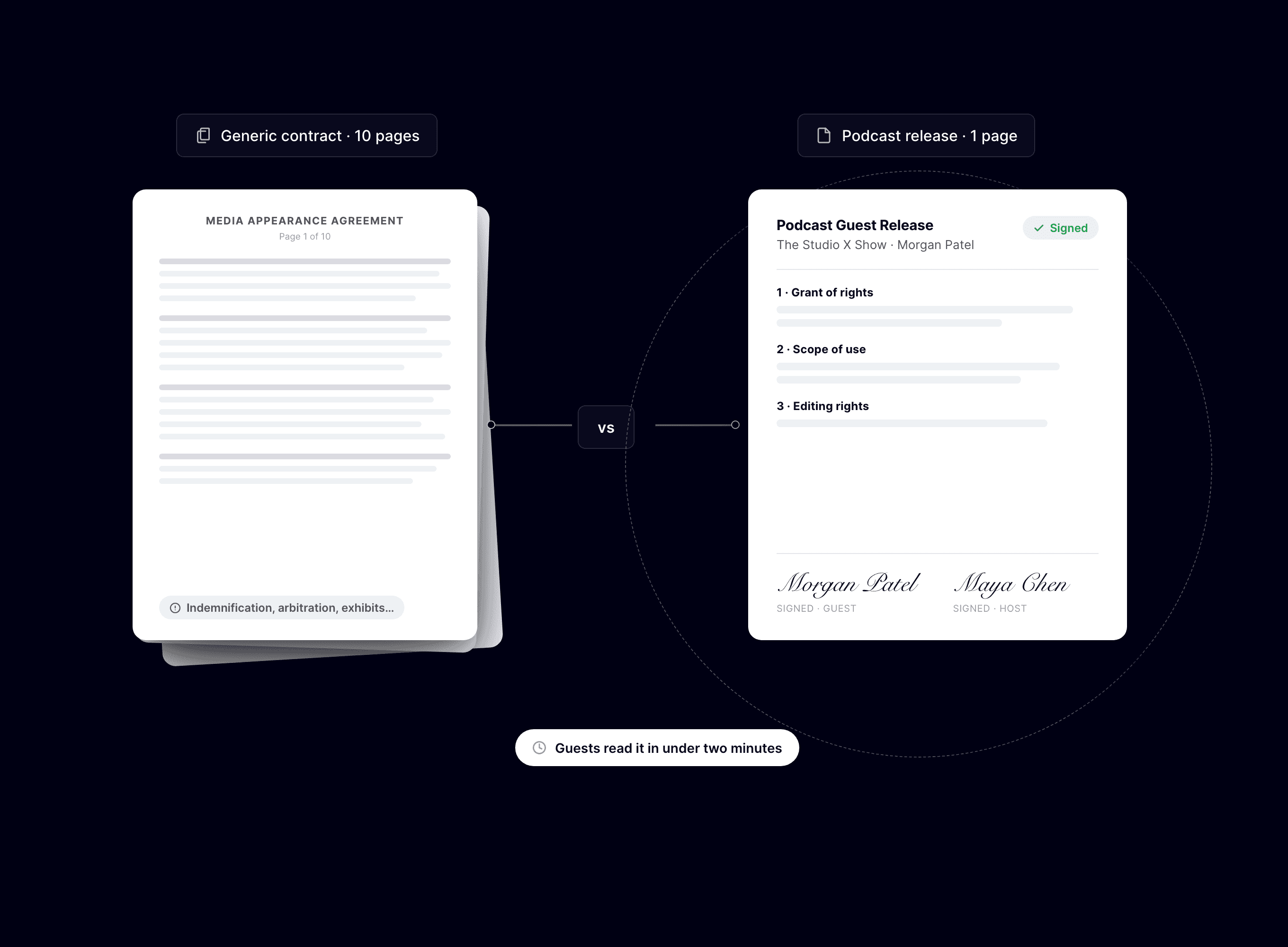
Search for a podcast release form template and you’ll find a mess: photography releases with the word “photo” swapped for “podcast,” film location agreements, and ten-page contracts written for TV productions. Most of them are either overkill or the wrong kill entirely.
A podcast release doesn’t need to be complicated. It needs to cover a specific, short list of things — and skip the clauses that scare guests without protecting you.
This guide walks through what a good template includes, what to leave out, and how to spot a template that wasn’t written for podcasting. One quick disclaimer: this is general information, not legal advice — for your specific situation, talk to a lawyer.
Key takeaway
A good podcast release template covers rights, scope of use, editing, compensation, warranties, governing law, and signatures.
Skip exclusivity clauses, indemnification overkill, and anything you can’t explain to a guest in one sentence.
Generic media releases often miss podcast realities like clips, feeds, and multi-platform distribution.
Fill-in fields should be minimal: podcast name, guest details, and governing state.
A one-to-two-page release gets signed; a ten-page contract gets ignored.
The sections every template needs
Strip away the formatting and a solid podcast release template has seven working parts:
Identification: your podcast’s name and the guest’s name, so it’s clear who’s agreeing with whom.
Grant of rights: permission to record and use the guest’s voice, likeness, name, and statements.
Scope of use: episodes, clips, transcripts, promotional material, across any platform or format.
Editing rights: permission to cut, condense, and rearrange the recording.
Compensation statement: typically that the guest appears voluntarily without payment.
Warranties and governing law: the guest confirms they can make these promises, and you name a US state whose law governs.
Signatures and dates: both the guest and someone representing the show.
Each of these earns its place. If a guest asks “why is this in here?” you should have a one-sentence answer for every clause.
What to skip
Templates written for other industries drag in clauses that don’t belong in a podcast release. Common ones to cut:
Exclusivity: you almost never need to stop a guest from appearing on other shows, and asking will spook them.
Non-disparagement: heavy-handed for a conversation the guest chose to have.
Broad indemnification: fine for a film production, alarming in a 30-minute interview context.
Moral rights waivers copied from other countries’ law: often irrelevant for a US-governed release.
Payment schedules and invoicing terms: pointless when nobody is being paid.
Every extra clause is another reason for a guest to say “let me have my lawyer look at this,” which is where signing momentum goes to die.
Why generic templates miss the mark
Most free templates online were written for photography, film, or general media appearances. Podcasting has its own realities that those templates don’t contemplate.
A podcast episode doesn’t live in one place. It syndicates through an RSS feed to a dozen apps, gets clipped for social, may get a transcript, and might end up on YouTube. A release that only mentions “the program” or “the photograph” leaves all of that ambiguous.
Editing is the other gap. Podcast interviews get cut down, rearranged, and excerpted as a matter of course. A generic appearance release may not grant editing rights at all — which means your standard workflow technically exceeds your permission.
Keep the fill-in fields minimal
A sign of a well-designed template: how little you have to fill in per guest. Ideally it’s just three things.
Your podcast’s name (set once, reused forever).
The guest’s name and email.
The governing US state.
If a template makes you rewrite paragraphs for every guest, it’s not a template — it’s a drafting exercise. Templates should make the per-guest work trivial so you actually use them for every episode, not just the ones you remember.
Template vs. tool
A Word document template still leaves you with the logistics: converting to PDF, emailing it, chasing the signature, filing the signed copy, and remembering who has and hasn’t returned theirs.
That’s why many podcasters graduate from a template to a tool that handles the sending, signing, and storage. The document matters, but the workflow around it is what determines whether releases actually get signed.
Conclusion
The best podcast release form template is short, podcast-specific, and easy enough that you send it for every single guest without thinking. Cover the seven core sections, cut the enterprise clutter, and keep the per-guest fields to a minimum.
Or skip the template hunt entirely: BuzzyPod ships with a ready-written podcast guest release built in — you fill in the podcast name, guest details, and governing state, preview the PDF live, and send it for e-signature, all for $10/month.
Related reading
Introduction
Search for a podcast release form template and you’ll find a mess: photography releases with the word “photo” swapped for “podcast,” film location agreements, and ten-page contracts written for TV productions. Most of them are either overkill or the wrong kill entirely.
A podcast release doesn’t need to be complicated. It needs to cover a specific, short list of things — and skip the clauses that scare guests without protecting you.
This guide walks through what a good template includes, what to leave out, and how to spot a template that wasn’t written for podcasting. One quick disclaimer: this is general information, not legal advice — for your specific situation, talk to a lawyer.
Key takeaway
A good podcast release template covers rights, scope of use, editing, compensation, warranties, governing law, and signatures.
Skip exclusivity clauses, indemnification overkill, and anything you can’t explain to a guest in one sentence.
Generic media releases often miss podcast realities like clips, feeds, and multi-platform distribution.
Fill-in fields should be minimal: podcast name, guest details, and governing state.
A one-to-two-page release gets signed; a ten-page contract gets ignored.
The sections every template needs
Strip away the formatting and a solid podcast release template has seven working parts:
Identification: your podcast’s name and the guest’s name, so it’s clear who’s agreeing with whom.
Grant of rights: permission to record and use the guest’s voice, likeness, name, and statements.
Scope of use: episodes, clips, transcripts, promotional material, across any platform or format.
Editing rights: permission to cut, condense, and rearrange the recording.
Compensation statement: typically that the guest appears voluntarily without payment.
Warranties and governing law: the guest confirms they can make these promises, and you name a US state whose law governs.
Signatures and dates: both the guest and someone representing the show.
Each of these earns its place. If a guest asks “why is this in here?” you should have a one-sentence answer for every clause.
What to skip
Templates written for other industries drag in clauses that don’t belong in a podcast release. Common ones to cut:
Exclusivity: you almost never need to stop a guest from appearing on other shows, and asking will spook them.
Non-disparagement: heavy-handed for a conversation the guest chose to have.
Broad indemnification: fine for a film production, alarming in a 30-minute interview context.
Moral rights waivers copied from other countries’ law: often irrelevant for a US-governed release.
Payment schedules and invoicing terms: pointless when nobody is being paid.
Every extra clause is another reason for a guest to say “let me have my lawyer look at this,” which is where signing momentum goes to die.
Why generic templates miss the mark
Most free templates online were written for photography, film, or general media appearances. Podcasting has its own realities that those templates don’t contemplate.
A podcast episode doesn’t live in one place. It syndicates through an RSS feed to a dozen apps, gets clipped for social, may get a transcript, and might end up on YouTube. A release that only mentions “the program” or “the photograph” leaves all of that ambiguous.
Editing is the other gap. Podcast interviews get cut down, rearranged, and excerpted as a matter of course. A generic appearance release may not grant editing rights at all — which means your standard workflow technically exceeds your permission.
Keep the fill-in fields minimal
A sign of a well-designed template: how little you have to fill in per guest. Ideally it’s just three things.
Your podcast’s name (set once, reused forever).
The guest’s name and email.
The governing US state.
If a template makes you rewrite paragraphs for every guest, it’s not a template — it’s a drafting exercise. Templates should make the per-guest work trivial so you actually use them for every episode, not just the ones you remember.
Template vs. tool
A Word document template still leaves you with the logistics: converting to PDF, emailing it, chasing the signature, filing the signed copy, and remembering who has and hasn’t returned theirs.
That’s why many podcasters graduate from a template to a tool that handles the sending, signing, and storage. The document matters, but the workflow around it is what determines whether releases actually get signed.
Conclusion
The best podcast release form template is short, podcast-specific, and easy enough that you send it for every single guest without thinking. Cover the seven core sections, cut the enterprise clutter, and keep the per-guest fields to a minimum.
Or skip the template hunt entirely: BuzzyPod ships with a ready-written podcast guest release built in — you fill in the podcast name, guest details, and governing state, preview the PDF live, and send it for e-signature, all for $10/month.
Related reading
Introduction
Search for a podcast release form template and you’ll find a mess: photography releases with the word “photo” swapped for “podcast,” film location agreements, and ten-page contracts written for TV productions. Most of them are either overkill or the wrong kill entirely.
A podcast release doesn’t need to be complicated. It needs to cover a specific, short list of things — and skip the clauses that scare guests without protecting you.
This guide walks through what a good template includes, what to leave out, and how to spot a template that wasn’t written for podcasting. One quick disclaimer: this is general information, not legal advice — for your specific situation, talk to a lawyer.
Key takeaway
A good podcast release template covers rights, scope of use, editing, compensation, warranties, governing law, and signatures.
Skip exclusivity clauses, indemnification overkill, and anything you can’t explain to a guest in one sentence.
Generic media releases often miss podcast realities like clips, feeds, and multi-platform distribution.
Fill-in fields should be minimal: podcast name, guest details, and governing state.
A one-to-two-page release gets signed; a ten-page contract gets ignored.
The sections every template needs
Strip away the formatting and a solid podcast release template has seven working parts:
Identification: your podcast’s name and the guest’s name, so it’s clear who’s agreeing with whom.
Grant of rights: permission to record and use the guest’s voice, likeness, name, and statements.
Scope of use: episodes, clips, transcripts, promotional material, across any platform or format.
Editing rights: permission to cut, condense, and rearrange the recording.
Compensation statement: typically that the guest appears voluntarily without payment.
Warranties and governing law: the guest confirms they can make these promises, and you name a US state whose law governs.
Signatures and dates: both the guest and someone representing the show.
Each of these earns its place. If a guest asks “why is this in here?” you should have a one-sentence answer for every clause.
What to skip
Templates written for other industries drag in clauses that don’t belong in a podcast release. Common ones to cut:
Exclusivity: you almost never need to stop a guest from appearing on other shows, and asking will spook them.
Non-disparagement: heavy-handed for a conversation the guest chose to have.
Broad indemnification: fine for a film production, alarming in a 30-minute interview context.
Moral rights waivers copied from other countries’ law: often irrelevant for a US-governed release.
Payment schedules and invoicing terms: pointless when nobody is being paid.
Every extra clause is another reason for a guest to say “let me have my lawyer look at this,” which is where signing momentum goes to die.
Why generic templates miss the mark
Most free templates online were written for photography, film, or general media appearances. Podcasting has its own realities that those templates don’t contemplate.
A podcast episode doesn’t live in one place. It syndicates through an RSS feed to a dozen apps, gets clipped for social, may get a transcript, and might end up on YouTube. A release that only mentions “the program” or “the photograph” leaves all of that ambiguous.
Editing is the other gap. Podcast interviews get cut down, rearranged, and excerpted as a matter of course. A generic appearance release may not grant editing rights at all — which means your standard workflow technically exceeds your permission.
Keep the fill-in fields minimal
A sign of a well-designed template: how little you have to fill in per guest. Ideally it’s just three things.
Your podcast’s name (set once, reused forever).
The guest’s name and email.
The governing US state.
If a template makes you rewrite paragraphs for every guest, it’s not a template — it’s a drafting exercise. Templates should make the per-guest work trivial so you actually use them for every episode, not just the ones you remember.
Template vs. tool
A Word document template still leaves you with the logistics: converting to PDF, emailing it, chasing the signature, filing the signed copy, and remembering who has and hasn’t returned theirs.
That’s why many podcasters graduate from a template to a tool that handles the sending, signing, and storage. The document matters, but the workflow around it is what determines whether releases actually get signed.
Conclusion
The best podcast release form template is short, podcast-specific, and easy enough that you send it for every single guest without thinking. Cover the seven core sections, cut the enterprise clutter, and keep the per-guest fields to a minimum.
Or skip the template hunt entirely: BuzzyPod ships with a ready-written podcast guest release built in — you fill in the podcast name, guest details, and governing state, preview the PDF live, and send it for e-signature, all for $10/month.

