Do you need a release form for your podcast? A plain-English guide

Nathaniel DeSantis
Release Forms & Legal

Introduction
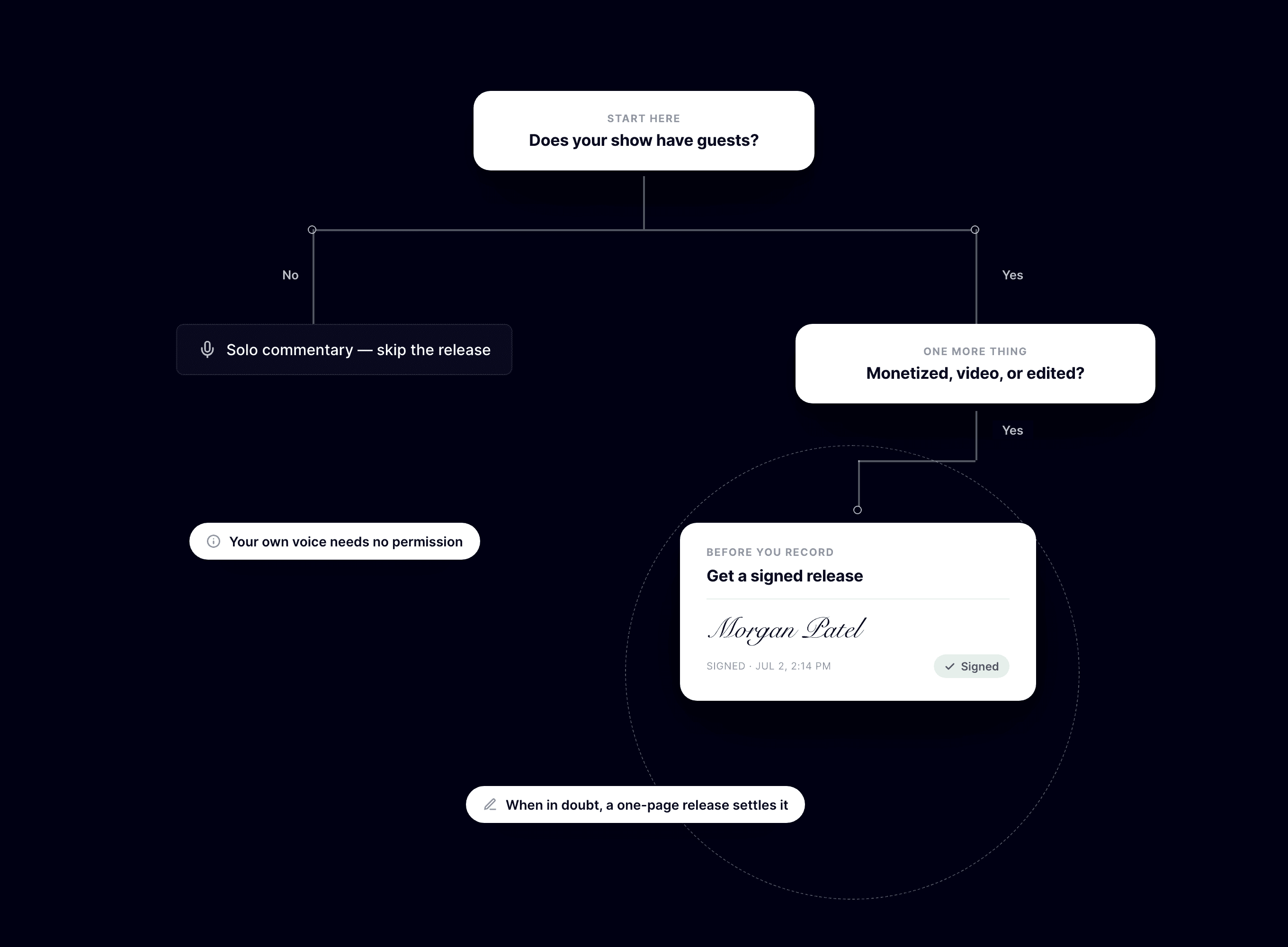
Do you need a release form for your podcast? Honest answer: not always. If it’s just you and a microphone, there’s nobody to get permission from. But the moment another voice enters your feed, the calculation changes — and it changes faster than most hosts expect.
The tricky part is that skipping releases feels fine right up until it isn’t. The risk isn’t the recording day; it’s two years later, when the episode is still earning and the relationship with the guest has changed.
This guide sorts podcasting situations into “you can skip it,” “you probably want one,” and “don’t publish without it.” As always, this is general information, not legal advice — for your specific situation, talk to a lawyer.
Key takeaway
Solo shows with no guests don’t need release forms — there’s no one to release anything.
Any show with guests benefits from written consent, even if it’s casual.
Monetization, heavy editing, video, and sponsors move releases from “nice” to “necessary.”
Retroactive permission is much harder to get than upfront permission.
A release documents consent and reduces risk — it’s cheap insurance, not bureaucracy.
When you can genuinely skip it
Some shows really don’t need release forms, and pretending otherwise would be scaremongering.
Solo commentary or narrative shows: it’s your voice, your rights, your feed.
Co-hosted shows where the co-hosts share ownership: your arrangement belongs in a partnership or collaboration agreement, not a guest release.
Internal-only recordings that will never be published anywhere.
If nobody outside the show’s owners appears in the published audio, a guest release has no job to do.
When you probably want one
The gray zone is small shows with occasional guests and no money involved. Legally, the stakes are lower here — but the cost of a release is so small that skipping it rarely makes sense.
A signed release helps even for a hobby show because it sets expectations. The guest knows the episode will be edited, published widely, and stay up. You know they know. Most disputes are really just mismatched expectations wearing a legal costume.
And here’s the practical problem with waiting: shows change. The hobby project that starts selling ads in year two now has a back catalog full of episodes recorded on handshakes.
When you really shouldn’t publish without one
Certain situations raise both the odds of a dispute and the cost of losing one. If any of these describe your show, get releases signed before recording:
Monetization: ads, sponsorships, subscriptions, or affiliate revenue attached to episodes.
Heavy editing: you cut, rearrange, or excerpt conversations rather than publishing raw.
Video: the guest’s face appears on YouTube, clips, thumbnails, or social posts.
Sponsor requirements: many sponsors and networks expect you to have rights documentation.
Wide distribution or repurposing: clips, transcripts, compilations, or licensing the content elsewhere.
Sensitive topics: health, legal trouble, employers, or anything a guest might later regret discussing.
In each case, the release does the same quiet work: it documents that the guest consented to exactly the thing you’re doing with the recording.
The retroactive-permission trap
Hosts who skip releases usually plan to “sort it out later if it matters.” Later is the worst possible time.
Before recording, a release is a routine formality and guests sign without a second thought. After publication — especially after a disagreement — the same document becomes a negotiation, and you’re the one who needs something.
Some guests will have moved on, changed emails, or fallen out with you. A back catalog without releases isn’t a crisis, but cleaning it up is genuinely tedious. Starting the habit now is far easier.
What “getting a release” actually takes
The reason to say yes to releases is that the cost has collapsed. The modern workflow is roughly this:
Fill in the guest’s name and email in a ready-made form.
Send them a secure signing link along with the booking details.
They tap the link and sign on their phone — no account, no printer.
Both of you automatically receive the executed PDF for your records.
That’s a two-minute task per guest. Weighed against even one takedown demand on a monetized episode, it’s not a close call.
Conclusion
So: solo show, skip it. Guests but zero stakes, it’s still smart. Money, editing, video, or sponsors in the picture — treat a signed release as part of publishing, same as your episode artwork.
If you want the two-minute version of this workflow, BuzzyPod includes a ready-made guest release with e-signing, status tracking, and automatic PDF delivery for $10/month flat — with a 14-day free trial to test it on your next booking.
Related reading
Introduction
Do you need a release form for your podcast? Honest answer: not always. If it’s just you and a microphone, there’s nobody to get permission from. But the moment another voice enters your feed, the calculation changes — and it changes faster than most hosts expect.
The tricky part is that skipping releases feels fine right up until it isn’t. The risk isn’t the recording day; it’s two years later, when the episode is still earning and the relationship with the guest has changed.
This guide sorts podcasting situations into “you can skip it,” “you probably want one,” and “don’t publish without it.” As always, this is general information, not legal advice — for your specific situation, talk to a lawyer.
Key takeaway
Solo shows with no guests don’t need release forms — there’s no one to release anything.
Any show with guests benefits from written consent, even if it’s casual.
Monetization, heavy editing, video, and sponsors move releases from “nice” to “necessary.”
Retroactive permission is much harder to get than upfront permission.
A release documents consent and reduces risk — it’s cheap insurance, not bureaucracy.
When you can genuinely skip it
Some shows really don’t need release forms, and pretending otherwise would be scaremongering.
Solo commentary or narrative shows: it’s your voice, your rights, your feed.
Co-hosted shows where the co-hosts share ownership: your arrangement belongs in a partnership or collaboration agreement, not a guest release.
Internal-only recordings that will never be published anywhere.
If nobody outside the show’s owners appears in the published audio, a guest release has no job to do.
When you probably want one
The gray zone is small shows with occasional guests and no money involved. Legally, the stakes are lower here — but the cost of a release is so small that skipping it rarely makes sense.
A signed release helps even for a hobby show because it sets expectations. The guest knows the episode will be edited, published widely, and stay up. You know they know. Most disputes are really just mismatched expectations wearing a legal costume.
And here’s the practical problem with waiting: shows change. The hobby project that starts selling ads in year two now has a back catalog full of episodes recorded on handshakes.
When you really shouldn’t publish without one
Certain situations raise both the odds of a dispute and the cost of losing one. If any of these describe your show, get releases signed before recording:
Monetization: ads, sponsorships, subscriptions, or affiliate revenue attached to episodes.
Heavy editing: you cut, rearrange, or excerpt conversations rather than publishing raw.
Video: the guest’s face appears on YouTube, clips, thumbnails, or social posts.
Sponsor requirements: many sponsors and networks expect you to have rights documentation.
Wide distribution or repurposing: clips, transcripts, compilations, or licensing the content elsewhere.
Sensitive topics: health, legal trouble, employers, or anything a guest might later regret discussing.
In each case, the release does the same quiet work: it documents that the guest consented to exactly the thing you’re doing with the recording.
The retroactive-permission trap
Hosts who skip releases usually plan to “sort it out later if it matters.” Later is the worst possible time.
Before recording, a release is a routine formality and guests sign without a second thought. After publication — especially after a disagreement — the same document becomes a negotiation, and you’re the one who needs something.
Some guests will have moved on, changed emails, or fallen out with you. A back catalog without releases isn’t a crisis, but cleaning it up is genuinely tedious. Starting the habit now is far easier.
What “getting a release” actually takes
The reason to say yes to releases is that the cost has collapsed. The modern workflow is roughly this:
Fill in the guest’s name and email in a ready-made form.
Send them a secure signing link along with the booking details.
They tap the link and sign on their phone — no account, no printer.
Both of you automatically receive the executed PDF for your records.
That’s a two-minute task per guest. Weighed against even one takedown demand on a monetized episode, it’s not a close call.
Conclusion
So: solo show, skip it. Guests but zero stakes, it’s still smart. Money, editing, video, or sponsors in the picture — treat a signed release as part of publishing, same as your episode artwork.
If you want the two-minute version of this workflow, BuzzyPod includes a ready-made guest release with e-signing, status tracking, and automatic PDF delivery for $10/month flat — with a 14-day free trial to test it on your next booking.
Related reading
Introduction
Do you need a release form for your podcast? Honest answer: not always. If it’s just you and a microphone, there’s nobody to get permission from. But the moment another voice enters your feed, the calculation changes — and it changes faster than most hosts expect.
The tricky part is that skipping releases feels fine right up until it isn’t. The risk isn’t the recording day; it’s two years later, when the episode is still earning and the relationship with the guest has changed.
This guide sorts podcasting situations into “you can skip it,” “you probably want one,” and “don’t publish without it.” As always, this is general information, not legal advice — for your specific situation, talk to a lawyer.
Key takeaway
Solo shows with no guests don’t need release forms — there’s no one to release anything.
Any show with guests benefits from written consent, even if it’s casual.
Monetization, heavy editing, video, and sponsors move releases from “nice” to “necessary.”
Retroactive permission is much harder to get than upfront permission.
A release documents consent and reduces risk — it’s cheap insurance, not bureaucracy.
When you can genuinely skip it
Some shows really don’t need release forms, and pretending otherwise would be scaremongering.
Solo commentary or narrative shows: it’s your voice, your rights, your feed.
Co-hosted shows where the co-hosts share ownership: your arrangement belongs in a partnership or collaboration agreement, not a guest release.
Internal-only recordings that will never be published anywhere.
If nobody outside the show’s owners appears in the published audio, a guest release has no job to do.
When you probably want one
The gray zone is small shows with occasional guests and no money involved. Legally, the stakes are lower here — but the cost of a release is so small that skipping it rarely makes sense.
A signed release helps even for a hobby show because it sets expectations. The guest knows the episode will be edited, published widely, and stay up. You know they know. Most disputes are really just mismatched expectations wearing a legal costume.
And here’s the practical problem with waiting: shows change. The hobby project that starts selling ads in year two now has a back catalog full of episodes recorded on handshakes.
When you really shouldn’t publish without one
Certain situations raise both the odds of a dispute and the cost of losing one. If any of these describe your show, get releases signed before recording:
Monetization: ads, sponsorships, subscriptions, or affiliate revenue attached to episodes.
Heavy editing: you cut, rearrange, or excerpt conversations rather than publishing raw.
Video: the guest’s face appears on YouTube, clips, thumbnails, or social posts.
Sponsor requirements: many sponsors and networks expect you to have rights documentation.
Wide distribution or repurposing: clips, transcripts, compilations, or licensing the content elsewhere.
Sensitive topics: health, legal trouble, employers, or anything a guest might later regret discussing.
In each case, the release does the same quiet work: it documents that the guest consented to exactly the thing you’re doing with the recording.
The retroactive-permission trap
Hosts who skip releases usually plan to “sort it out later if it matters.” Later is the worst possible time.
Before recording, a release is a routine formality and guests sign without a second thought. After publication — especially after a disagreement — the same document becomes a negotiation, and you’re the one who needs something.
Some guests will have moved on, changed emails, or fallen out with you. A back catalog without releases isn’t a crisis, but cleaning it up is genuinely tedious. Starting the habit now is far easier.
What “getting a release” actually takes
The reason to say yes to releases is that the cost has collapsed. The modern workflow is roughly this:
Fill in the guest’s name and email in a ready-made form.
Send them a secure signing link along with the booking details.
They tap the link and sign on their phone — no account, no printer.
Both of you automatically receive the executed PDF for your records.
That’s a two-minute task per guest. Weighed against even one takedown demand on a monetized episode, it’s not a close call.
Conclusion
So: solo show, skip it. Guests but zero stakes, it’s still smart. Money, editing, video, or sponsors in the picture — treat a signed release as part of publishing, same as your episode artwork.
If you want the two-minute version of this workflow, BuzzyPod includes a ready-made guest release with e-signing, status tracking, and automatic PDF delivery for $10/month flat — with a 14-day free trial to test it on your next booking.

