Podcast release form vs. verbal consent: what actually protects your show

Nathaniel DeSantis
Release Forms & Legal

Introduction
Plenty of podcasters handle permissions the easy way: “You’re good with me publishing this, right?” — captured on the recording itself. So in the podcast release form vs. verbal consent debate, is that recorded yes enough, or do you need an actual signature?
Verbal consent isn’t worthless. A recorded, clear agreement is real evidence that the guest agreed to something. The problem is the word “something” — verbal consent is usually vague about scope, silent on editing, and fragile when memories diverge.
Let’s compare the two honestly, including where verbal consent is fine. This is general information, not legal advice — for your specific situation, talk to a lawyer.
Key takeaway
Recorded verbal consent is evidence of agreement, but it’s usually vague about scope and editing.
A written release nails down exactly what was agreed: rights, uses, platforms, and governing law.
Memory drift is the real enemy — written terms don’t fade or mutate over time.
Verbal consent proves a moment; a signed release with an audit trail proves a process.
For monetized, edited, or video shows, written wins on every axis except convenience.
What verbal consent actually gets you
Credit where due: on-tape consent captures a genuine agreement in the guest’s own voice, timestamped inside the recording itself. For a casual audio show, it documents the basic “yes, publish this.”
But listen closely to what’s typically said: “Sure, go ahead.” Go ahead with what, exactly?
Does “publish” include editing the conversation down or rearranging it?
Does it cover video, clips, Shorts, and using the guest’s face in a thumbnail?
Does it cover promotional use — quotes in newsletters, audiograms, ads for the episode?
Does it survive the guest changing their mind next year?
Which state’s law even applies if you disagree about all of the above?
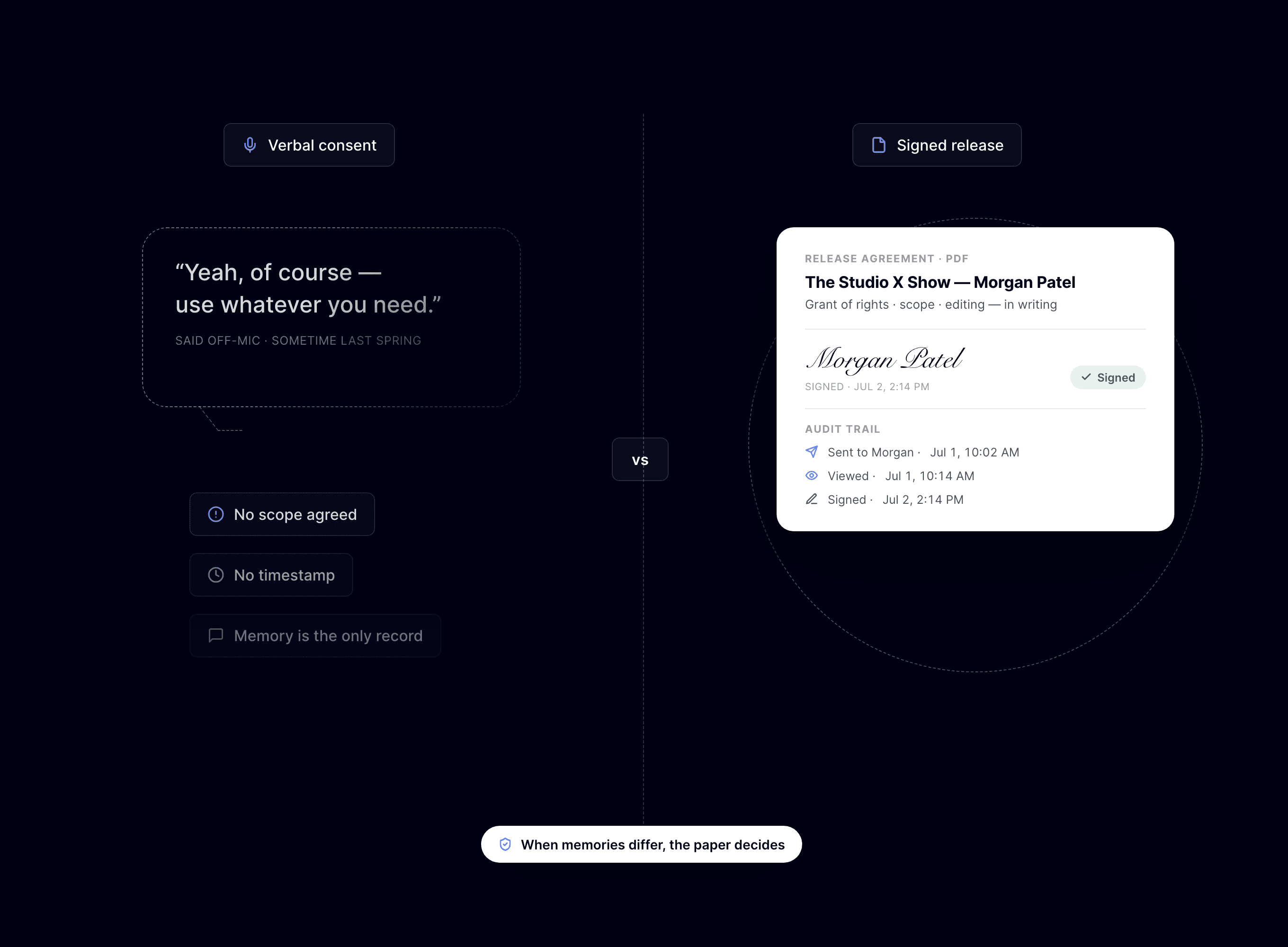
A verbal yes answers none of these. It documents that consent existed, not what it covered.
The scope problem
Most guest disputes aren’t “I never agreed to be recorded.” They’re “I didn’t agree to that” — the clip taken out of context, the episode still monetized years later, the thumbnail on YouTube.
Written releases exist precisely to close this gap. A good one spells out the grant of rights, the scope of use across formats and platforms, editing rights, compensation, and governing law. Every future “I didn’t agree to that” has a written answer.
The memory problem
Human memory is a terrible archive. Two honest people can walk away from the same conversation with different recollections of what was agreed — and both get more confident in their version over time.
Verbal consent lives inside that fog. A signed document doesn’t care what anyone remembers; it says what it said on the day it was signed. That’s the whole point of writing things down.
The proof problem
Suppose things do go wrong. What can you actually produce?
With verbal consent, you have an audio clip — assuming you kept the raw recording, the consent wasn’t edited out, and nobody argues about what the mumbled agreement meant.
With a properly executed e-signed release, you can produce quite a bit more:
The exact terms both parties agreed to, in writing.
A signature attributed to the guest’s email address.
A timestamped trail showing the form was created, sent, viewed, and signed.
A tamper-evident seal — a cryptographic hash that shows the document hasn’t been altered since signing.
One of these documents a process; the other preserves a moment. Neither makes you untouchable — but the written version reduces risk in a way a clip of “sure, go ahead” can’t.
When verbal is honestly fine
If your show is a hobby, audio-only, published mostly unedited, and earns nothing, recorded verbal consent covers the realistic risk. Lots of small shows run this way without incident.
The trouble is trajectory. Shows that grow inherit a back catalog of vague verbal agreements — and upgrading consent retroactively is far more awkward than collecting a signature upfront ever was. If there’s any chance your show becomes a business, start the written habit now.
Conclusion
Verbal consent proves your guest agreed to something. A written release proves what they agreed to — and modern e-signing makes it barely more effort than asking on tape. For any show with money, editing, or video involved, written is the clear winner.
If the paperwork side is what’s been stopping you, BuzzyPod’s built-in guest release takes about two minutes per guest: fill in their name and email, send the signing link, and both parties get the executed PDF automatically — $10/month, unlimited team seats.
Related reading
Introduction
Plenty of podcasters handle permissions the easy way: “You’re good with me publishing this, right?” — captured on the recording itself. So in the podcast release form vs. verbal consent debate, is that recorded yes enough, or do you need an actual signature?
Verbal consent isn’t worthless. A recorded, clear agreement is real evidence that the guest agreed to something. The problem is the word “something” — verbal consent is usually vague about scope, silent on editing, and fragile when memories diverge.
Let’s compare the two honestly, including where verbal consent is fine. This is general information, not legal advice — for your specific situation, talk to a lawyer.
Key takeaway
Recorded verbal consent is evidence of agreement, but it’s usually vague about scope and editing.
A written release nails down exactly what was agreed: rights, uses, platforms, and governing law.
Memory drift is the real enemy — written terms don’t fade or mutate over time.
Verbal consent proves a moment; a signed release with an audit trail proves a process.
For monetized, edited, or video shows, written wins on every axis except convenience.
What verbal consent actually gets you
Credit where due: on-tape consent captures a genuine agreement in the guest’s own voice, timestamped inside the recording itself. For a casual audio show, it documents the basic “yes, publish this.”
But listen closely to what’s typically said: “Sure, go ahead.” Go ahead with what, exactly?
Does “publish” include editing the conversation down or rearranging it?
Does it cover video, clips, Shorts, and using the guest’s face in a thumbnail?
Does it cover promotional use — quotes in newsletters, audiograms, ads for the episode?
Does it survive the guest changing their mind next year?
Which state’s law even applies if you disagree about all of the above?
A verbal yes answers none of these. It documents that consent existed, not what it covered.
The scope problem
Most guest disputes aren’t “I never agreed to be recorded.” They’re “I didn’t agree to that” — the clip taken out of context, the episode still monetized years later, the thumbnail on YouTube.
Written releases exist precisely to close this gap. A good one spells out the grant of rights, the scope of use across formats and platforms, editing rights, compensation, and governing law. Every future “I didn’t agree to that” has a written answer.
The memory problem
Human memory is a terrible archive. Two honest people can walk away from the same conversation with different recollections of what was agreed — and both get more confident in their version over time.
Verbal consent lives inside that fog. A signed document doesn’t care what anyone remembers; it says what it said on the day it was signed. That’s the whole point of writing things down.
The proof problem
Suppose things do go wrong. What can you actually produce?
With verbal consent, you have an audio clip — assuming you kept the raw recording, the consent wasn’t edited out, and nobody argues about what the mumbled agreement meant.
With a properly executed e-signed release, you can produce quite a bit more:
The exact terms both parties agreed to, in writing.
A signature attributed to the guest’s email address.
A timestamped trail showing the form was created, sent, viewed, and signed.
A tamper-evident seal — a cryptographic hash that shows the document hasn’t been altered since signing.
One of these documents a process; the other preserves a moment. Neither makes you untouchable — but the written version reduces risk in a way a clip of “sure, go ahead” can’t.
When verbal is honestly fine
If your show is a hobby, audio-only, published mostly unedited, and earns nothing, recorded verbal consent covers the realistic risk. Lots of small shows run this way without incident.
The trouble is trajectory. Shows that grow inherit a back catalog of vague verbal agreements — and upgrading consent retroactively is far more awkward than collecting a signature upfront ever was. If there’s any chance your show becomes a business, start the written habit now.
Conclusion
Verbal consent proves your guest agreed to something. A written release proves what they agreed to — and modern e-signing makes it barely more effort than asking on tape. For any show with money, editing, or video involved, written is the clear winner.
If the paperwork side is what’s been stopping you, BuzzyPod’s built-in guest release takes about two minutes per guest: fill in their name and email, send the signing link, and both parties get the executed PDF automatically — $10/month, unlimited team seats.
Related reading
Introduction
Plenty of podcasters handle permissions the easy way: “You’re good with me publishing this, right?” — captured on the recording itself. So in the podcast release form vs. verbal consent debate, is that recorded yes enough, or do you need an actual signature?
Verbal consent isn’t worthless. A recorded, clear agreement is real evidence that the guest agreed to something. The problem is the word “something” — verbal consent is usually vague about scope, silent on editing, and fragile when memories diverge.
Let’s compare the two honestly, including where verbal consent is fine. This is general information, not legal advice — for your specific situation, talk to a lawyer.
Key takeaway
Recorded verbal consent is evidence of agreement, but it’s usually vague about scope and editing.
A written release nails down exactly what was agreed: rights, uses, platforms, and governing law.
Memory drift is the real enemy — written terms don’t fade or mutate over time.
Verbal consent proves a moment; a signed release with an audit trail proves a process.
For monetized, edited, or video shows, written wins on every axis except convenience.
What verbal consent actually gets you
Credit where due: on-tape consent captures a genuine agreement in the guest’s own voice, timestamped inside the recording itself. For a casual audio show, it documents the basic “yes, publish this.”
But listen closely to what’s typically said: “Sure, go ahead.” Go ahead with what, exactly?
Does “publish” include editing the conversation down or rearranging it?
Does it cover video, clips, Shorts, and using the guest’s face in a thumbnail?
Does it cover promotional use — quotes in newsletters, audiograms, ads for the episode?
Does it survive the guest changing their mind next year?
Which state’s law even applies if you disagree about all of the above?
A verbal yes answers none of these. It documents that consent existed, not what it covered.
The scope problem
Most guest disputes aren’t “I never agreed to be recorded.” They’re “I didn’t agree to that” — the clip taken out of context, the episode still monetized years later, the thumbnail on YouTube.
Written releases exist precisely to close this gap. A good one spells out the grant of rights, the scope of use across formats and platforms, editing rights, compensation, and governing law. Every future “I didn’t agree to that” has a written answer.
The memory problem
Human memory is a terrible archive. Two honest people can walk away from the same conversation with different recollections of what was agreed — and both get more confident in their version over time.
Verbal consent lives inside that fog. A signed document doesn’t care what anyone remembers; it says what it said on the day it was signed. That’s the whole point of writing things down.
The proof problem
Suppose things do go wrong. What can you actually produce?
With verbal consent, you have an audio clip — assuming you kept the raw recording, the consent wasn’t edited out, and nobody argues about what the mumbled agreement meant.
With a properly executed e-signed release, you can produce quite a bit more:
The exact terms both parties agreed to, in writing.
A signature attributed to the guest’s email address.
A timestamped trail showing the form was created, sent, viewed, and signed.
A tamper-evident seal — a cryptographic hash that shows the document hasn’t been altered since signing.
One of these documents a process; the other preserves a moment. Neither makes you untouchable — but the written version reduces risk in a way a clip of “sure, go ahead” can’t.
When verbal is honestly fine
If your show is a hobby, audio-only, published mostly unedited, and earns nothing, recorded verbal consent covers the realistic risk. Lots of small shows run this way without incident.
The trouble is trajectory. Shows that grow inherit a back catalog of vague verbal agreements — and upgrading consent retroactively is far more awkward than collecting a signature upfront ever was. If there’s any chance your show becomes a business, start the written habit now.
Conclusion
Verbal consent proves your guest agreed to something. A written release proves what they agreed to — and modern e-signing makes it barely more effort than asking on tape. For any show with money, editing, or video involved, written is the clear winner.
If the paperwork side is what’s been stopping you, BuzzyPod’s built-in guest release takes about two minutes per guest: fill in their name and email, send the signing link, and both parties get the executed PDF automatically — $10/month, unlimited team seats.

