Podcast guest onboarding: from booking to signed release in one flow

Nathaniel DeSantis
Guest Management
Introduction
Between “yes, I’ll come on the show” and a published episode sits a stretch of logistics that makes or breaks the guest experience. Podcast guest onboarding is that stretch — and most shows run it from memory, differently every time.
The result is familiar: guests arrive unprepared, tech problems eat the first fifteen minutes, and the release form gets sent — if it gets sent — weeks after recording, when you have zero leverage and the guest has zero urgency.
Here’s a repeatable seven-step flow, plus the case for moving one step much earlier than most shows do.
Key takeaway
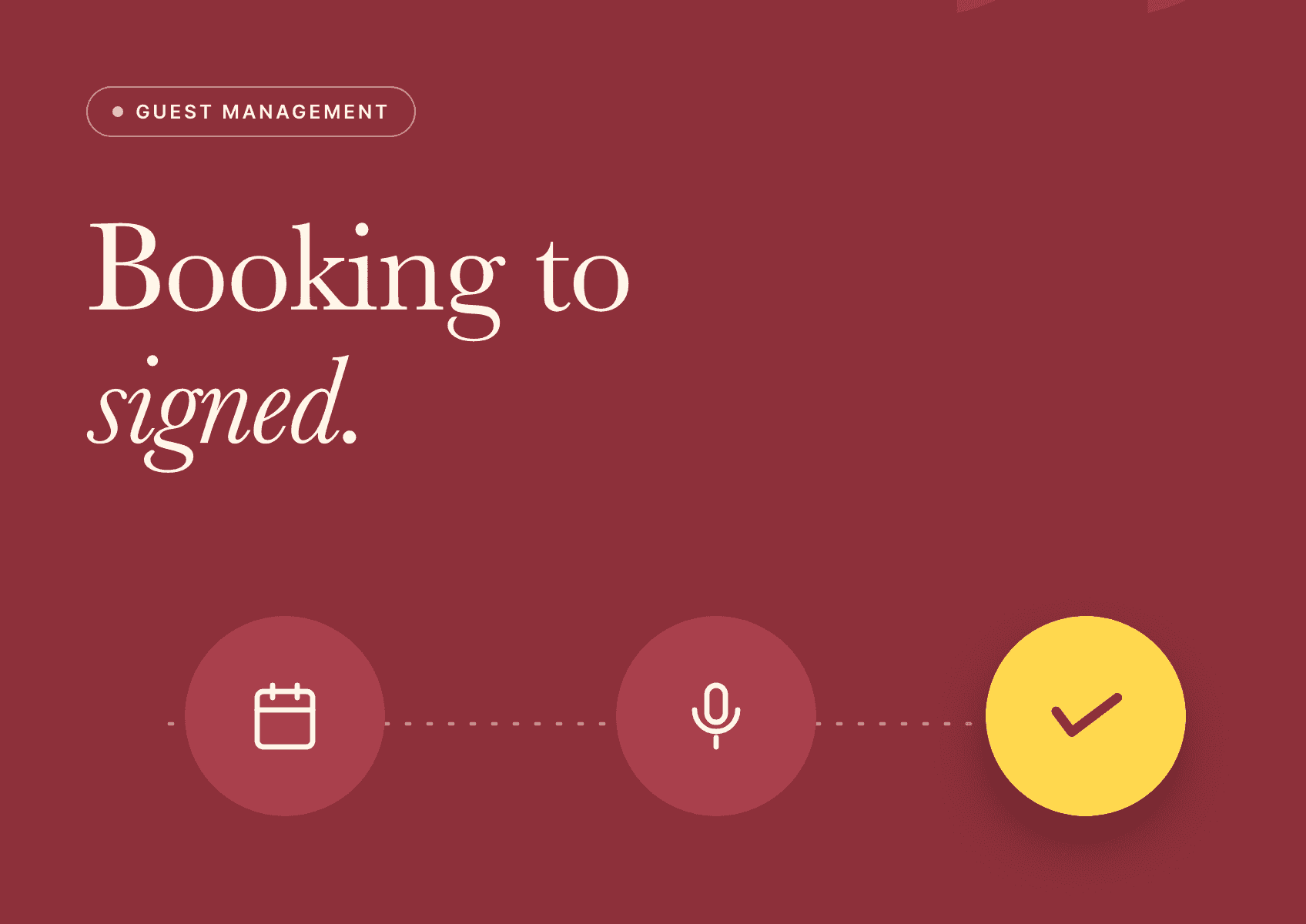
Guest onboarding is seven steps: confirm, prep, release, tech check, record, thank, share.
Send the release form before recording — it’s the step most shows do too late.
A signed release protects both sides and takes the guest two minutes on their phone.
Prep notes and a tech check prevent the two most common episode-killers.
Publish day is a marketing event: arm your guest with the link and assets.
The seven steps between yes and publish
Write this down once and reuse it for every guest:
Confirm the date within 24 hours of the yes, with a calendar invite.
Send prep notes: topic, sample questions, format, and how long you’ll need.
Send the guest release form — before recording, not after.
Do a tech check: headphones, mic, quiet room, stable connection.
Record, leaving five minutes at the start for small talk and levels.
Send a thank-you within a day, with a rough publish window.
On publish day, send the link plus anything shareable.
The rest of this post walks the steps that shows most often fumble.
Confirm fast, while the yes is warm
Enthusiasm decays. A guest who said yes on Tuesday and hears nothing until the following week starts wondering if the show is real.
Reply within a day with a specific date and a calendar invite — a scheduling link works fine if you’d rather they pick. The invite should carry the recording link and your contact info so the guest never has to search their inbox on the day.
Send the release before recording, not after
This is the step almost everyone does too late — or skips until an old episode suddenly needs to become a clip, an ad, or part of a sale, and there’s no paper anywhere.
The logic for sending it early is simple: before recording, signing is a two-minute formality attached to something the guest is excited about. After publishing, it’s a favor you’re asking of a busy stranger — and if they say no, you’ve got an episode you can’t safely use.
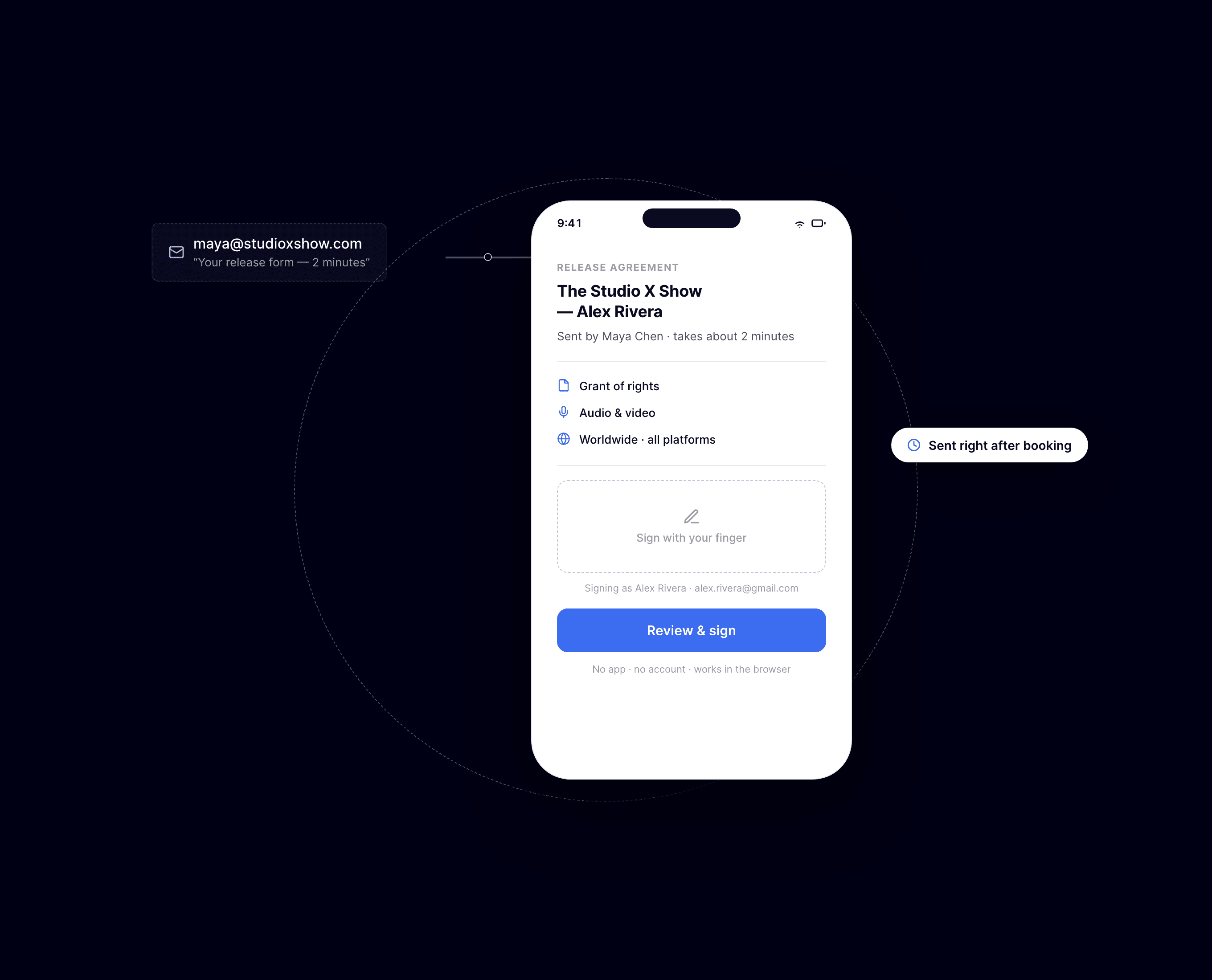
BuzzyPod makes the early send painless. The release is ready-written: you fill in the podcast name, guest email, and governing state, sign as the show’s representative, and the guest signs from a secure email link on any device — no account, no printer. The executed PDF goes to both parties automatically, sealed with a SHA-256 hash and a tamper-evident audit trail showing when it was created, sent, viewed, and signed. Status tracking (draft, pending, signed) tells you at a glance who still owes a signature, and you can resend or void as needed.
Prep notes and the tech check
Two things kill more episodes than anything else: guests who don’t know what you’ll ask, and audio recorded on laptop speakers in a kitchen.
Prep notes fix the first — a short doc with the angle, three to five sample questions, and the format. The tech check fixes the second: a five-minute call a few days out, or at minimum a checklist covering headphones, an external mic if they have one, a quiet room, and a hardwired or strong connection.
Record, thank, and arm them for publish day
After recording, send a genuine thank-you within a day and set expectations for when the episode ships. Silence between recording and publish is where guest goodwill goes to die.
On publish day, make sharing effortless:
The episode link, obviously.
One or two suggested social captions they can paste.
Any quote graphics or clips your team made.
A line inviting them back if it went well.
Guests who share can noticeably move an episode’s first-week numbers — you’ll see it in the daily download chart.
Conclusion
A guest who was confirmed quickly, prepped properly, and never chased for paperwork tells other potential guests it was easy — and easy is how booking pipelines grow.
If the release step is the one your show keeps doing too late, BuzzyPod’s built-in guest releases — e-signed from a link, tracked, and delivered to both parties automatically — make “before recording” the default instead of the exception.
Related reading
Introduction
Between “yes, I’ll come on the show” and a published episode sits a stretch of logistics that makes or breaks the guest experience. Podcast guest onboarding is that stretch — and most shows run it from memory, differently every time.
The result is familiar: guests arrive unprepared, tech problems eat the first fifteen minutes, and the release form gets sent — if it gets sent — weeks after recording, when you have zero leverage and the guest has zero urgency.
Here’s a repeatable seven-step flow, plus the case for moving one step much earlier than most shows do.
Key takeaway
Guest onboarding is seven steps: confirm, prep, release, tech check, record, thank, share.
Send the release form before recording — it’s the step most shows do too late.
A signed release protects both sides and takes the guest two minutes on their phone.
Prep notes and a tech check prevent the two most common episode-killers.
Publish day is a marketing event: arm your guest with the link and assets.
The seven steps between yes and publish
Write this down once and reuse it for every guest:
Confirm the date within 24 hours of the yes, with a calendar invite.
Send prep notes: topic, sample questions, format, and how long you’ll need.
Send the guest release form — before recording, not after.
Do a tech check: headphones, mic, quiet room, stable connection.
Record, leaving five minutes at the start for small talk and levels.
Send a thank-you within a day, with a rough publish window.
On publish day, send the link plus anything shareable.
The rest of this post walks the steps that shows most often fumble.
Confirm fast, while the yes is warm
Enthusiasm decays. A guest who said yes on Tuesday and hears nothing until the following week starts wondering if the show is real.
Reply within a day with a specific date and a calendar invite — a scheduling link works fine if you’d rather they pick. The invite should carry the recording link and your contact info so the guest never has to search their inbox on the day.
Send the release before recording, not after
This is the step almost everyone does too late — or skips until an old episode suddenly needs to become a clip, an ad, or part of a sale, and there’s no paper anywhere.
The logic for sending it early is simple: before recording, signing is a two-minute formality attached to something the guest is excited about. After publishing, it’s a favor you’re asking of a busy stranger — and if they say no, you’ve got an episode you can’t safely use.
BuzzyPod makes the early send painless. The release is ready-written: you fill in the podcast name, guest email, and governing state, sign as the show’s representative, and the guest signs from a secure email link on any device — no account, no printer. The executed PDF goes to both parties automatically, sealed with a SHA-256 hash and a tamper-evident audit trail showing when it was created, sent, viewed, and signed. Status tracking (draft, pending, signed) tells you at a glance who still owes a signature, and you can resend or void as needed.
Prep notes and the tech check
Two things kill more episodes than anything else: guests who don’t know what you’ll ask, and audio recorded on laptop speakers in a kitchen.
Prep notes fix the first — a short doc with the angle, three to five sample questions, and the format. The tech check fixes the second: a five-minute call a few days out, or at minimum a checklist covering headphones, an external mic if they have one, a quiet room, and a hardwired or strong connection.
Record, thank, and arm them for publish day
After recording, send a genuine thank-you within a day and set expectations for when the episode ships. Silence between recording and publish is where guest goodwill goes to die.
On publish day, make sharing effortless:
The episode link, obviously.
One or two suggested social captions they can paste.
Any quote graphics or clips your team made.
A line inviting them back if it went well.
Guests who share can noticeably move an episode’s first-week numbers — you’ll see it in the daily download chart.
Conclusion
A guest who was confirmed quickly, prepped properly, and never chased for paperwork tells other potential guests it was easy — and easy is how booking pipelines grow.
If the release step is the one your show keeps doing too late, BuzzyPod’s built-in guest releases — e-signed from a link, tracked, and delivered to both parties automatically — make “before recording” the default instead of the exception.
Related reading
Introduction
Between “yes, I’ll come on the show” and a published episode sits a stretch of logistics that makes or breaks the guest experience. Podcast guest onboarding is that stretch — and most shows run it from memory, differently every time.
The result is familiar: guests arrive unprepared, tech problems eat the first fifteen minutes, and the release form gets sent — if it gets sent — weeks after recording, when you have zero leverage and the guest has zero urgency.
Here’s a repeatable seven-step flow, plus the case for moving one step much earlier than most shows do.
Key takeaway
Guest onboarding is seven steps: confirm, prep, release, tech check, record, thank, share.
Send the release form before recording — it’s the step most shows do too late.
A signed release protects both sides and takes the guest two minutes on their phone.
Prep notes and a tech check prevent the two most common episode-killers.
Publish day is a marketing event: arm your guest with the link and assets.
The seven steps between yes and publish
Write this down once and reuse it for every guest:
Confirm the date within 24 hours of the yes, with a calendar invite.
Send prep notes: topic, sample questions, format, and how long you’ll need.
Send the guest release form — before recording, not after.
Do a tech check: headphones, mic, quiet room, stable connection.
Record, leaving five minutes at the start for small talk and levels.
Send a thank-you within a day, with a rough publish window.
On publish day, send the link plus anything shareable.
The rest of this post walks the steps that shows most often fumble.
Confirm fast, while the yes is warm
Enthusiasm decays. A guest who said yes on Tuesday and hears nothing until the following week starts wondering if the show is real.
Reply within a day with a specific date and a calendar invite — a scheduling link works fine if you’d rather they pick. The invite should carry the recording link and your contact info so the guest never has to search their inbox on the day.
Send the release before recording, not after
This is the step almost everyone does too late — or skips until an old episode suddenly needs to become a clip, an ad, or part of a sale, and there’s no paper anywhere.
The logic for sending it early is simple: before recording, signing is a two-minute formality attached to something the guest is excited about. After publishing, it’s a favor you’re asking of a busy stranger — and if they say no, you’ve got an episode you can’t safely use.
BuzzyPod makes the early send painless. The release is ready-written: you fill in the podcast name, guest email, and governing state, sign as the show’s representative, and the guest signs from a secure email link on any device — no account, no printer. The executed PDF goes to both parties automatically, sealed with a SHA-256 hash and a tamper-evident audit trail showing when it was created, sent, viewed, and signed. Status tracking (draft, pending, signed) tells you at a glance who still owes a signature, and you can resend or void as needed.
Prep notes and the tech check
Two things kill more episodes than anything else: guests who don’t know what you’ll ask, and audio recorded on laptop speakers in a kitchen.
Prep notes fix the first — a short doc with the angle, three to five sample questions, and the format. The tech check fixes the second: a five-minute call a few days out, or at minimum a checklist covering headphones, an external mic if they have one, a quiet room, and a hardwired or strong connection.
Record, thank, and arm them for publish day
After recording, send a genuine thank-you within a day and set expectations for when the episode ships. Silence between recording and publish is where guest goodwill goes to die.
On publish day, make sharing effortless:
The episode link, obviously.
One or two suggested social captions they can paste.
Any quote graphics or clips your team made.
A line inviting them back if it went well.
Guests who share can noticeably move an episode’s first-week numbers — you’ll see it in the daily download chart.
Conclusion
A guest who was confirmed quickly, prepped properly, and never chased for paperwork tells other potential guests it was easy — and easy is how booking pipelines grow.
If the release step is the one your show keeps doing too late, BuzzyPod’s built-in guest releases — e-signed from a link, tracked, and delivered to both parties automatically — make “before recording” the default instead of the exception.

