Podcast CPM rates: what sponsors pay and why your download count matters

Nathaniel DeSantis
Sponsorship & Monetization

Introduction
Podcast CPM rates are the pricing language of podcast advertising, and if you plan to make sponsor money, you need to speak it fluently. CPM means “cost per mille” — the price an advertiser pays per 1,000 downloads.
The good news: the math is simple. The catch: the math runs on your download count, which means how your downloads get measured directly determines what you invoice. A counting gap isn’t a rounding error — it’s money.
Here is how CPM works, what sponsors typically pay, and why accurate cross-app counting is quietly the most important line item in your ad business.
Key takeaway
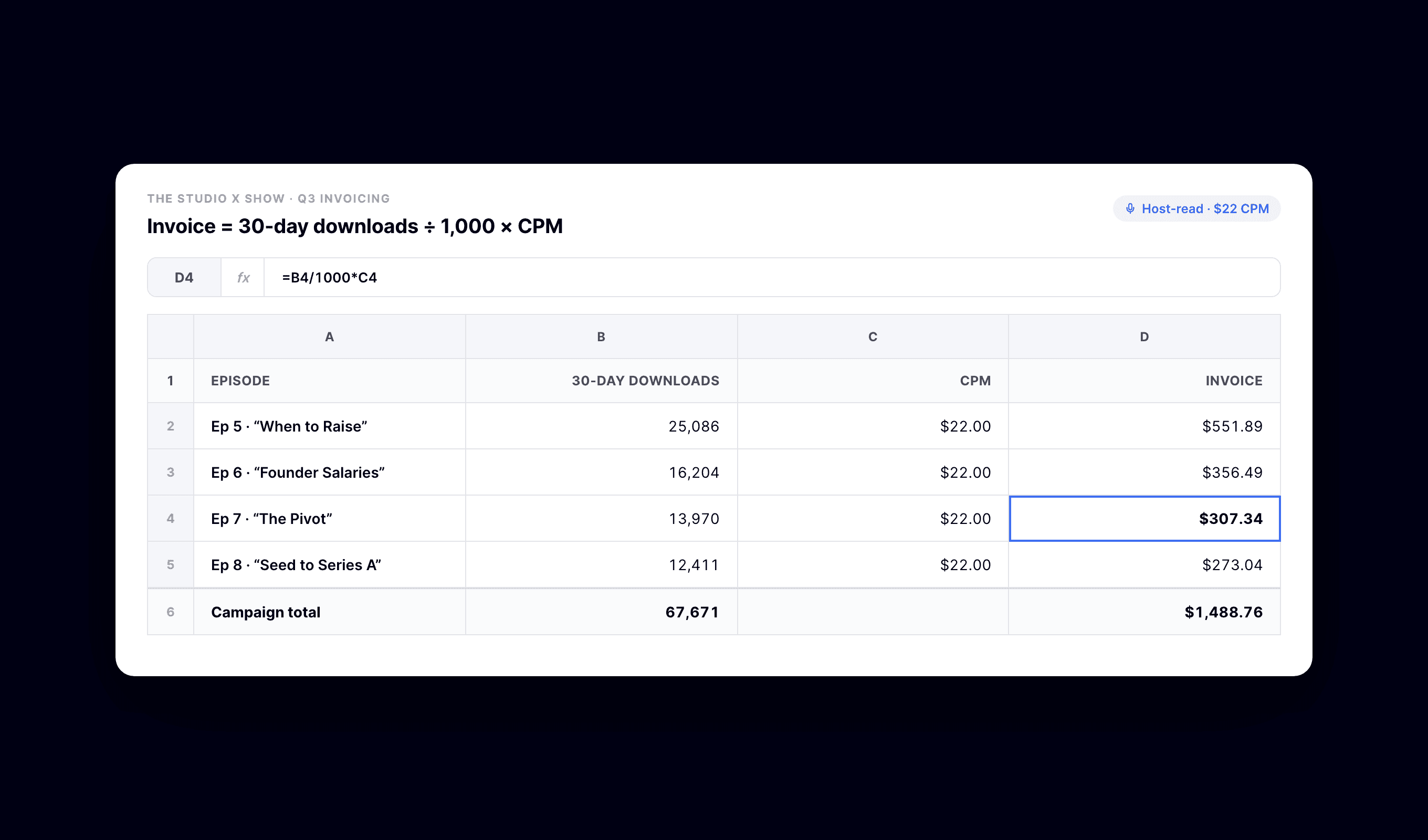
CPM = cost per 1,000 downloads; the invoice is downloads ÷ 1,000 × CPM
Host-read podcast ads are commonly cited around $15–$30 CPM, with mid-roll at the higher end
Sponsors buy against downloads in the first 30 days after release
Niche B2B shows can sometimes command more than general-interest shows with bigger audiences
Undercounted downloads mean underbilled invoices — measurement is money
The CPM math, once and for all
Take your expected downloads, divide by 1,000, multiply by the CPM. That is the whole formula.
An episode expected to earn 8,000 downloads in its first 30 days, sold at a $25 CPM, prices out at 8 × $25 = $200 for that spot. A weekly show at that level is looking at roughly $800 a month from a single ad slot.
Estimate 30-day downloads per episode from your recent average
Divide by 1,000
Multiply by the agreed CPM
Multiply by the number of episodes in the flight
What sponsors typically pay
Commonly cited ranges for host-read podcast ads sit roughly between $15 and $30 CPM. Pre-roll spots typically price at the lower end, while mid-roll — where listeners are most engaged — commands the higher end.
Audience fit moves the number more than audience size. Niche B2B shows with a few thousand highly specific listeners can sometimes command CPMs above these ranges, because reaching 2,000 procurement managers is worth more to the right sponsor than reaching 50,000 random commuters.
Host-read vs. programmatic
Host-read ads are the spots you voice yourself, usually sold directly to a sponsor. Programmatic ads are inserted automatically by ad platforms and sold in bulk.
Host-read: higher CPMs, direct sponsor relationships, your voice and endorsement — and your admin work
Programmatic: lower CPMs, zero sales effort, less control over what runs on your show
Many independent shows do best selling host-read directly and skipping programmatic entirely at smaller sizes
If you sell direct, you are the ad ops department — which is exactly why your measurement and reporting need to be tight.
The 30-day window: what you’re actually selling
Sponsors buy downloads within 30 days of episode release. Not all-time downloads, not projected downloads — the standard unit is that first 30-day window.
So quote your rates from a recent average of 30-day performance, and track each sponsored episode’s daily curve so you can show delivery, not just claim it.
Why accurate counting changes your invoice
Here is the part podcasters underrate: at a $25 CPM, every 1,000 downloads your analytics fail to count is $25 you did not bill. If your measurement misses downloads from some listening apps, that gap compounds across every episode and every flight.
This is why measurement choice is a revenue decision, not a nerd preference. BuzzyPod’s analytics are powered by OP3, an open, prefix-based service that counts downloads consistently across all listening apps — so the number on your invoice matches what actually happened, and you can show a sponsor exactly how it was measured.
Quoting your first rate
Do not agonize. Take your recent 30-day average, price mid-roll somewhere in the commonly cited range, and put it in your media kit as a starting point.
Quote a per-episode flat price derived from the CPM math — small sponsors prefer flat numbers
Offer a modest discount for multi-episode commitments
Revisit rates quarterly as your average moves
Always state the measurement source; it preempts the awkward “says who?” question
Conclusion
CPM is simple arithmetic sitting on top of one critical input: a download count both you and your sponsor trust. Get the counting right, quote against 30-day performance, and the pricing conversation gets a lot less awkward.
BuzzyPod gives you OP3-powered download counts, daily curves for every episode, and one-click CSV exports to back up your invoices — all for $10 a month with a 14-day free trial.
Related reading
Introduction
Podcast CPM rates are the pricing language of podcast advertising, and if you plan to make sponsor money, you need to speak it fluently. CPM means “cost per mille” — the price an advertiser pays per 1,000 downloads.
The good news: the math is simple. The catch: the math runs on your download count, which means how your downloads get measured directly determines what you invoice. A counting gap isn’t a rounding error — it’s money.
Here is how CPM works, what sponsors typically pay, and why accurate cross-app counting is quietly the most important line item in your ad business.
Key takeaway
CPM = cost per 1,000 downloads; the invoice is downloads ÷ 1,000 × CPM
Host-read podcast ads are commonly cited around $15–$30 CPM, with mid-roll at the higher end
Sponsors buy against downloads in the first 30 days after release
Niche B2B shows can sometimes command more than general-interest shows with bigger audiences
Undercounted downloads mean underbilled invoices — measurement is money
The CPM math, once and for all
Take your expected downloads, divide by 1,000, multiply by the CPM. That is the whole formula.
An episode expected to earn 8,000 downloads in its first 30 days, sold at a $25 CPM, prices out at 8 × $25 = $200 for that spot. A weekly show at that level is looking at roughly $800 a month from a single ad slot.
Estimate 30-day downloads per episode from your recent average
Divide by 1,000
Multiply by the agreed CPM
Multiply by the number of episodes in the flight
What sponsors typically pay
Commonly cited ranges for host-read podcast ads sit roughly between $15 and $30 CPM. Pre-roll spots typically price at the lower end, while mid-roll — where listeners are most engaged — commands the higher end.
Audience fit moves the number more than audience size. Niche B2B shows with a few thousand highly specific listeners can sometimes command CPMs above these ranges, because reaching 2,000 procurement managers is worth more to the right sponsor than reaching 50,000 random commuters.
Host-read vs. programmatic
Host-read ads are the spots you voice yourself, usually sold directly to a sponsor. Programmatic ads are inserted automatically by ad platforms and sold in bulk.
Host-read: higher CPMs, direct sponsor relationships, your voice and endorsement — and your admin work
Programmatic: lower CPMs, zero sales effort, less control over what runs on your show
Many independent shows do best selling host-read directly and skipping programmatic entirely at smaller sizes
If you sell direct, you are the ad ops department — which is exactly why your measurement and reporting need to be tight.
The 30-day window: what you’re actually selling
Sponsors buy downloads within 30 days of episode release. Not all-time downloads, not projected downloads — the standard unit is that first 30-day window.
So quote your rates from a recent average of 30-day performance, and track each sponsored episode’s daily curve so you can show delivery, not just claim it.
Why accurate counting changes your invoice
Here is the part podcasters underrate: at a $25 CPM, every 1,000 downloads your analytics fail to count is $25 you did not bill. If your measurement misses downloads from some listening apps, that gap compounds across every episode and every flight.
This is why measurement choice is a revenue decision, not a nerd preference. BuzzyPod’s analytics are powered by OP3, an open, prefix-based service that counts downloads consistently across all listening apps — so the number on your invoice matches what actually happened, and you can show a sponsor exactly how it was measured.
Quoting your first rate
Do not agonize. Take your recent 30-day average, price mid-roll somewhere in the commonly cited range, and put it in your media kit as a starting point.
Quote a per-episode flat price derived from the CPM math — small sponsors prefer flat numbers
Offer a modest discount for multi-episode commitments
Revisit rates quarterly as your average moves
Always state the measurement source; it preempts the awkward “says who?” question
Conclusion
CPM is simple arithmetic sitting on top of one critical input: a download count both you and your sponsor trust. Get the counting right, quote against 30-day performance, and the pricing conversation gets a lot less awkward.
BuzzyPod gives you OP3-powered download counts, daily curves for every episode, and one-click CSV exports to back up your invoices — all for $10 a month with a 14-day free trial.
Related reading
Introduction
Podcast CPM rates are the pricing language of podcast advertising, and if you plan to make sponsor money, you need to speak it fluently. CPM means “cost per mille” — the price an advertiser pays per 1,000 downloads.
The good news: the math is simple. The catch: the math runs on your download count, which means how your downloads get measured directly determines what you invoice. A counting gap isn’t a rounding error — it’s money.
Here is how CPM works, what sponsors typically pay, and why accurate cross-app counting is quietly the most important line item in your ad business.
Key takeaway
CPM = cost per 1,000 downloads; the invoice is downloads ÷ 1,000 × CPM
Host-read podcast ads are commonly cited around $15–$30 CPM, with mid-roll at the higher end
Sponsors buy against downloads in the first 30 days after release
Niche B2B shows can sometimes command more than general-interest shows with bigger audiences
Undercounted downloads mean underbilled invoices — measurement is money
The CPM math, once and for all
Take your expected downloads, divide by 1,000, multiply by the CPM. That is the whole formula.
An episode expected to earn 8,000 downloads in its first 30 days, sold at a $25 CPM, prices out at 8 × $25 = $200 for that spot. A weekly show at that level is looking at roughly $800 a month from a single ad slot.
Estimate 30-day downloads per episode from your recent average
Divide by 1,000
Multiply by the agreed CPM
Multiply by the number of episodes in the flight
What sponsors typically pay
Commonly cited ranges for host-read podcast ads sit roughly between $15 and $30 CPM. Pre-roll spots typically price at the lower end, while mid-roll — where listeners are most engaged — commands the higher end.
Audience fit moves the number more than audience size. Niche B2B shows with a few thousand highly specific listeners can sometimes command CPMs above these ranges, because reaching 2,000 procurement managers is worth more to the right sponsor than reaching 50,000 random commuters.
Host-read vs. programmatic
Host-read ads are the spots you voice yourself, usually sold directly to a sponsor. Programmatic ads are inserted automatically by ad platforms and sold in bulk.
Host-read: higher CPMs, direct sponsor relationships, your voice and endorsement — and your admin work
Programmatic: lower CPMs, zero sales effort, less control over what runs on your show
Many independent shows do best selling host-read directly and skipping programmatic entirely at smaller sizes
If you sell direct, you are the ad ops department — which is exactly why your measurement and reporting need to be tight.
The 30-day window: what you’re actually selling
Sponsors buy downloads within 30 days of episode release. Not all-time downloads, not projected downloads — the standard unit is that first 30-day window.
So quote your rates from a recent average of 30-day performance, and track each sponsored episode’s daily curve so you can show delivery, not just claim it.
Why accurate counting changes your invoice
Here is the part podcasters underrate: at a $25 CPM, every 1,000 downloads your analytics fail to count is $25 you did not bill. If your measurement misses downloads from some listening apps, that gap compounds across every episode and every flight.
This is why measurement choice is a revenue decision, not a nerd preference. BuzzyPod’s analytics are powered by OP3, an open, prefix-based service that counts downloads consistently across all listening apps — so the number on your invoice matches what actually happened, and you can show a sponsor exactly how it was measured.
Quoting your first rate
Do not agonize. Take your recent 30-day average, price mid-roll somewhere in the commonly cited range, and put it in your media kit as a starting point.
Quote a per-episode flat price derived from the CPM math — small sponsors prefer flat numbers
Offer a modest discount for multi-episode commitments
Revisit rates quarterly as your average moves
Always state the measurement source; it preempts the awkward “says who?” question
Conclusion
CPM is simple arithmetic sitting on top of one critical input: a download count both you and your sponsor trust. Get the counting right, quote against 30-day performance, and the pricing conversation gets a lot less awkward.
BuzzyPod gives you OP3-powered download counts, daily curves for every episode, and one-click CSV exports to back up your invoices — all for $10 a month with a 14-day free trial.

