How many downloads is a good podcast? Benchmarks by show age and niche

Nathaniel DeSantis
Podcast Analytics

Introduction
“How many downloads is a good podcast?” is the question every podcaster secretly Googles at 11pm. The honest answer is lower than you think — and more nuanced than a single number.
Commonly cited industry medians from large hosts like Libsyn and Buzzsprout suggest that an episode pulling around 30 downloads in its first 7 days already beats roughly half of all shows. A few hundred puts you well into the top half. Thousands per episode approaches the top few percent.
This post breaks those benchmarks down by show age and niche, and explains why your monetization goal matters more than your percentile.
Key takeaway
~30 downloads in 7 days beats roughly half of all shows, per commonly cited host stats
A few hundred per episode is comfortably top-half; thousands approaches the top few percent
Benchmarks shift with show age — measure episodes at the same age, not raw totals
Niche size caps your ceiling but often raises your value per listener
Your monetization path decides what “enough” means, not a leaderboard
The benchmarks, with appropriate hedging
No one has a complete census of podcasting, so all benchmarks come from hosting providers publishing stats about their own customers. Treat these as commonly cited reference points, not physics:
~30 downloads in the first 7 days: better than about 50% of shows
~100–150 in the first week: roughly top quarter territory
Several hundred per episode: comfortably in the top 10–20%
Thousands per episode: approaching the top few percent of all podcasts
Notice how steep that curve is. Podcasting is a long-tail medium — a huge number of shows are small, which means modest, consistent growth moves you up the distribution surprisingly fast.
Why show age changes everything
A 10-episode show and a 200-episode show playing to the same benchmark is not a fair comparison. Older shows benefit from back-catalog downloads, accumulated search presence, and years of word of mouth.
A more useful frame by rough show age:
Months 0–6: any consistent number above zero-friends-and-family is a win; watch whether each episode’s first week beats the last
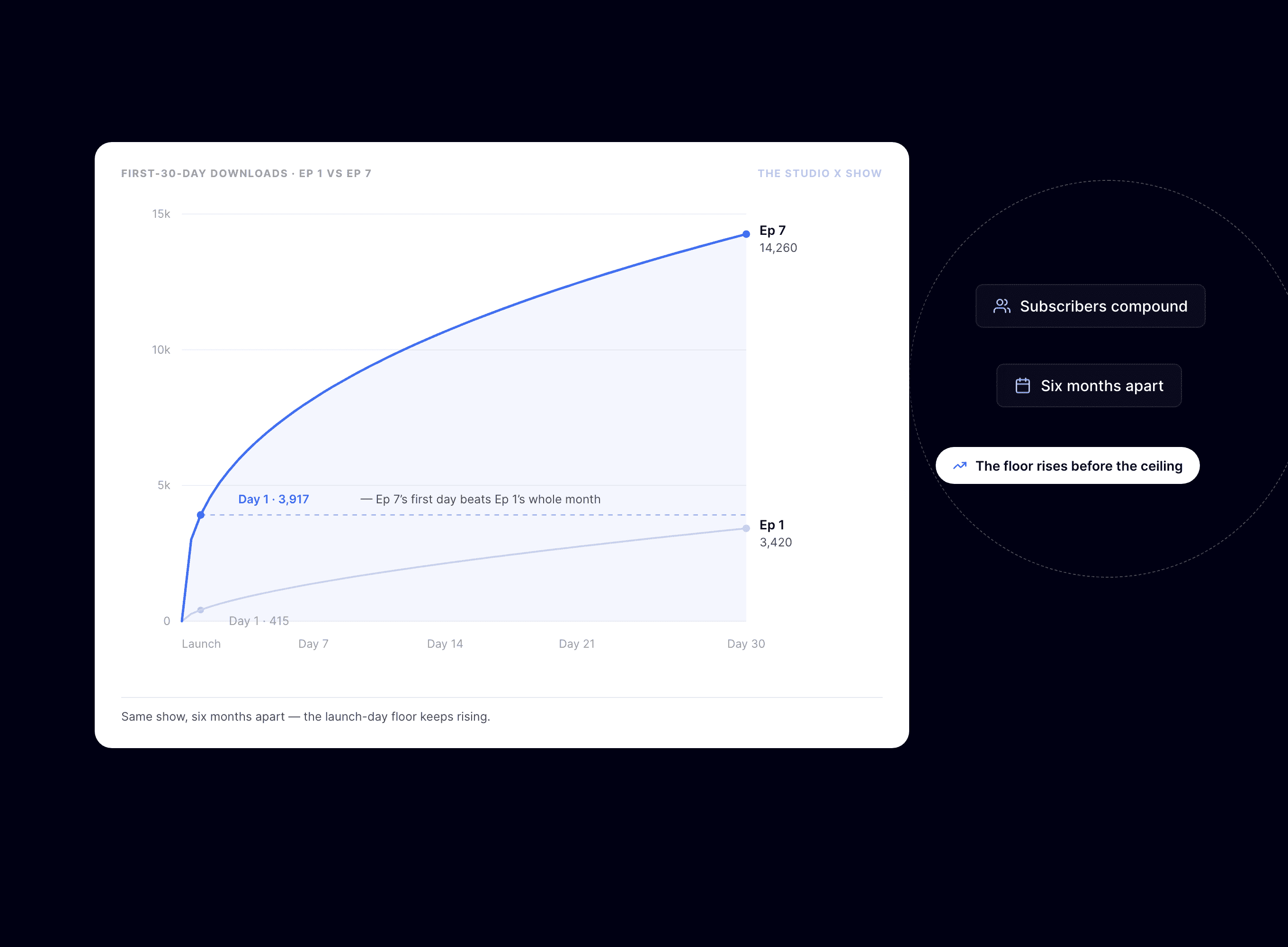
Months 6–18: look for a rising floor — your worst episode this quarter should beat your worst episode last quarter
Year 2 and beyond: back-catalog tail should be a meaningful slice of monthly downloads; flat here means new-listener acquisition has stalled
This is why comparing episodes aligned by days-from-launch matters so much. Episode 8’s first 30 days versus episode 30’s first 30 days is the honest growth chart.
Niche changes the math more than effort does
A true-crime show and a podcast for pediatric dental practice managers live in different universes. The dental show might cap out at 800 downloads an episode — and be far more lucrative.
Small, specific audiences are often worth more per listener:
Niche B2B shows can charge premium sponsorship rates because every listener is a potential customer
A consulting or services business behind the show may only need a handful of clients per year from it
Broad entertainment shows need scale because CPM advertising pays per thousand downloads
So before you envy a bigger show’s numbers, ask what a listener is worth to each of you.
Set a goal-based target instead of chasing rank
Work backwards from what you actually want:
CPM sponsorships: most networks and marketplaces want a few thousand downloads per episode, so that’s your line
Direct niche sponsors: a few hundred highly targeted downloads can be sellable today
Leads for your business: track downloads in your buyer’s geography, not the global total
Audience for its own sake: consistency and a rising floor beat any absolute number
One consistent measurement source matters here, because a sponsor conversation goes sideways fast when your numbers come from three dashboards that disagree.
Conclusion
A “good” podcast download number is smaller than the internet makes you feel, heavily dependent on show age and niche, and ultimately defined by your goal. Beat your own last quarter and you’re doing better than most.
If you want one trustworthy, cross-app number to benchmark against — with episode comparisons aligned from launch day — BuzzyPod does exactly that for $10/month, with a 14-day free trial.
Related reading
Introduction
“How many downloads is a good podcast?” is the question every podcaster secretly Googles at 11pm. The honest answer is lower than you think — and more nuanced than a single number.
Commonly cited industry medians from large hosts like Libsyn and Buzzsprout suggest that an episode pulling around 30 downloads in its first 7 days already beats roughly half of all shows. A few hundred puts you well into the top half. Thousands per episode approaches the top few percent.
This post breaks those benchmarks down by show age and niche, and explains why your monetization goal matters more than your percentile.
Key takeaway
~30 downloads in 7 days beats roughly half of all shows, per commonly cited host stats
A few hundred per episode is comfortably top-half; thousands approaches the top few percent
Benchmarks shift with show age — measure episodes at the same age, not raw totals
Niche size caps your ceiling but often raises your value per listener
Your monetization path decides what “enough” means, not a leaderboard
The benchmarks, with appropriate hedging
No one has a complete census of podcasting, so all benchmarks come from hosting providers publishing stats about their own customers. Treat these as commonly cited reference points, not physics:
~30 downloads in the first 7 days: better than about 50% of shows
~100–150 in the first week: roughly top quarter territory
Several hundred per episode: comfortably in the top 10–20%
Thousands per episode: approaching the top few percent of all podcasts
Notice how steep that curve is. Podcasting is a long-tail medium — a huge number of shows are small, which means modest, consistent growth moves you up the distribution surprisingly fast.
Why show age changes everything
A 10-episode show and a 200-episode show playing to the same benchmark is not a fair comparison. Older shows benefit from back-catalog downloads, accumulated search presence, and years of word of mouth.
A more useful frame by rough show age:
Months 0–6: any consistent number above zero-friends-and-family is a win; watch whether each episode’s first week beats the last
Months 6–18: look for a rising floor — your worst episode this quarter should beat your worst episode last quarter
Year 2 and beyond: back-catalog tail should be a meaningful slice of monthly downloads; flat here means new-listener acquisition has stalled
This is why comparing episodes aligned by days-from-launch matters so much. Episode 8’s first 30 days versus episode 30’s first 30 days is the honest growth chart.
Niche changes the math more than effort does
A true-crime show and a podcast for pediatric dental practice managers live in different universes. The dental show might cap out at 800 downloads an episode — and be far more lucrative.
Small, specific audiences are often worth more per listener:
Niche B2B shows can charge premium sponsorship rates because every listener is a potential customer
A consulting or services business behind the show may only need a handful of clients per year from it
Broad entertainment shows need scale because CPM advertising pays per thousand downloads
So before you envy a bigger show’s numbers, ask what a listener is worth to each of you.
Set a goal-based target instead of chasing rank
Work backwards from what you actually want:
CPM sponsorships: most networks and marketplaces want a few thousand downloads per episode, so that’s your line
Direct niche sponsors: a few hundred highly targeted downloads can be sellable today
Leads for your business: track downloads in your buyer’s geography, not the global total
Audience for its own sake: consistency and a rising floor beat any absolute number
One consistent measurement source matters here, because a sponsor conversation goes sideways fast when your numbers come from three dashboards that disagree.
Conclusion
A “good” podcast download number is smaller than the internet makes you feel, heavily dependent on show age and niche, and ultimately defined by your goal. Beat your own last quarter and you’re doing better than most.
If you want one trustworthy, cross-app number to benchmark against — with episode comparisons aligned from launch day — BuzzyPod does exactly that for $10/month, with a 14-day free trial.
Related reading
Introduction
“How many downloads is a good podcast?” is the question every podcaster secretly Googles at 11pm. The honest answer is lower than you think — and more nuanced than a single number.
Commonly cited industry medians from large hosts like Libsyn and Buzzsprout suggest that an episode pulling around 30 downloads in its first 7 days already beats roughly half of all shows. A few hundred puts you well into the top half. Thousands per episode approaches the top few percent.
This post breaks those benchmarks down by show age and niche, and explains why your monetization goal matters more than your percentile.
Key takeaway
~30 downloads in 7 days beats roughly half of all shows, per commonly cited host stats
A few hundred per episode is comfortably top-half; thousands approaches the top few percent
Benchmarks shift with show age — measure episodes at the same age, not raw totals
Niche size caps your ceiling but often raises your value per listener
Your monetization path decides what “enough” means, not a leaderboard
The benchmarks, with appropriate hedging
No one has a complete census of podcasting, so all benchmarks come from hosting providers publishing stats about their own customers. Treat these as commonly cited reference points, not physics:
~30 downloads in the first 7 days: better than about 50% of shows
~100–150 in the first week: roughly top quarter territory
Several hundred per episode: comfortably in the top 10–20%
Thousands per episode: approaching the top few percent of all podcasts
Notice how steep that curve is. Podcasting is a long-tail medium — a huge number of shows are small, which means modest, consistent growth moves you up the distribution surprisingly fast.
Why show age changes everything
A 10-episode show and a 200-episode show playing to the same benchmark is not a fair comparison. Older shows benefit from back-catalog downloads, accumulated search presence, and years of word of mouth.
A more useful frame by rough show age:
Months 0–6: any consistent number above zero-friends-and-family is a win; watch whether each episode’s first week beats the last
Months 6–18: look for a rising floor — your worst episode this quarter should beat your worst episode last quarter
Year 2 and beyond: back-catalog tail should be a meaningful slice of monthly downloads; flat here means new-listener acquisition has stalled
This is why comparing episodes aligned by days-from-launch matters so much. Episode 8’s first 30 days versus episode 30’s first 30 days is the honest growth chart.
Niche changes the math more than effort does
A true-crime show and a podcast for pediatric dental practice managers live in different universes. The dental show might cap out at 800 downloads an episode — and be far more lucrative.
Small, specific audiences are often worth more per listener:
Niche B2B shows can charge premium sponsorship rates because every listener is a potential customer
A consulting or services business behind the show may only need a handful of clients per year from it
Broad entertainment shows need scale because CPM advertising pays per thousand downloads
So before you envy a bigger show’s numbers, ask what a listener is worth to each of you.
Set a goal-based target instead of chasing rank
Work backwards from what you actually want:
CPM sponsorships: most networks and marketplaces want a few thousand downloads per episode, so that’s your line
Direct niche sponsors: a few hundred highly targeted downloads can be sellable today
Leads for your business: track downloads in your buyer’s geography, not the global total
Audience for its own sake: consistency and a rising floor beat any absolute number
One consistent measurement source matters here, because a sponsor conversation goes sideways fast when your numbers come from three dashboards that disagree.
Conclusion
A “good” podcast download number is smaller than the internet makes you feel, heavily dependent on show age and niche, and ultimately defined by your goal. Beat your own last quarter and you’re doing better than most.
If you want one trustworthy, cross-app number to benchmark against — with episode comparisons aligned from launch day — BuzzyPod does exactly that for $10/month, with a 14-day free trial.

