Podcast production workflow: the roles every growing show needs

Nathaniel DeSantis
Teams & Agencies

Introduction
Every podcast starts as one person doing five jobs. A healthy podcast production workflow is what happens when you notice which of those jobs you’re bad at — or sick of — and hand it to someone who isn’t.
The trick is sequencing. Hire in the wrong order and you’ve got a marketer promoting episodes that ship late because nobody owns editing. Hire in the right order and each new person removes your current biggest bottleneck.
Here’s the role-by-role playbook: what each person does, when to bring them on, and — the part almost everyone skips — what they should and shouldn’t be able to touch in your accounts.
Key takeaway
Five roles cover most growing shows: host, producer, editor, booker, marketer.
Add roles in order of your biggest bottleneck, not job-title prestige.
Access should match the job: editors don’t need billing, marketers do need analytics.
An owner/admin/member model maps cleanly onto podcast teams.
Write the workflow down before you hire — people can’t follow a process that lives in your head.
The five roles, in plain terms
Titles vary wildly across shows, so think in jobs, not titles:
Host — the voice and the point of view; owns the conversation and the audience relationship.
Producer — owns the calendar and the standard; makes sure episodes actually ship.
Editor — turns raw recordings into the thing people hear; owns audio quality.
Booker or guest coordinator — finds guests, confirms dates, handles prep and paperwork.
Marketer — clips, posts, newsletters; turns each episode into ten pieces of promotion.
On a two-person show, one human wears several of these hats. That’s fine — the point is that each hat has a clear owner.
When to add each role
Hire against your bottleneck. For most shows, the pain arrives in a predictable order:
Editor first — editing is the most learnable-by-someone-else task and the biggest time sink for hosts.
Booker second, if you’re an interview show — outreach and scheduling quietly eat entire afternoons.
Producer third — once episodes and people multiply, someone has to own the whole pipeline.
Marketer last — promotion only compounds when the machine behind it is reliable.
A useful rule: if a task delays publishing two weeks in a row, that task is your next hire or contractor.
Map people to access, not job titles
Here’s where most teams get sloppy. They hire well, then hand everyone the same shared login, so the freelance editor has the same power as the co-founder.
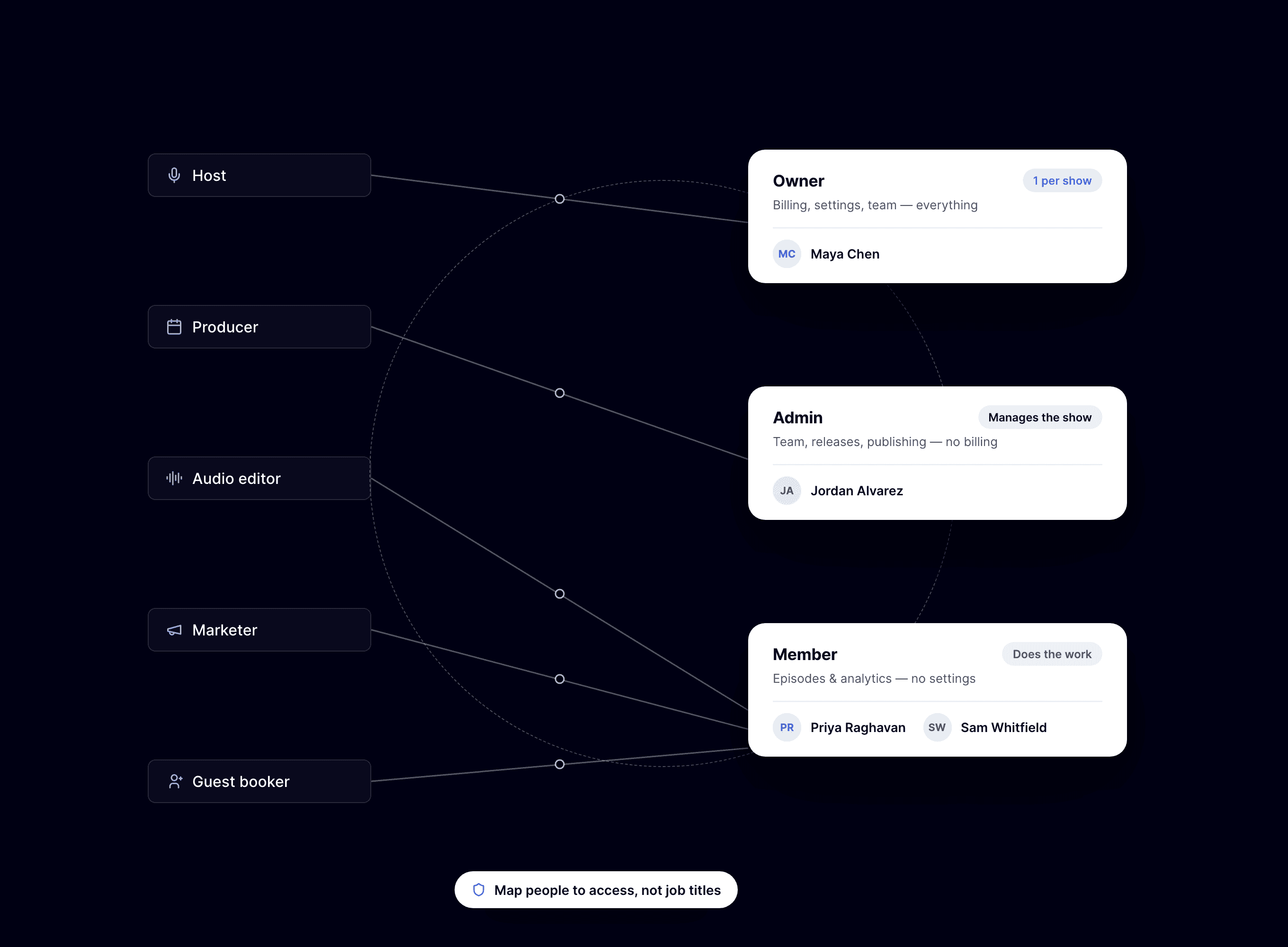
Access should mirror the job. In BuzzyPod’s model that looks like: owners run the account, admins manage billing and people, and members work the show without touching settings.
Host or show owner — owner role; they answer for the whole operation.
Producer — admin; they add and remove people and may handle the subscription.
Editor — member; they need to work in the show, not reconfigure it.
Booker — member; they live in guest workflows like release forms, not in settings.
Marketer — member; they need analytics and exports, not the billing page.
Who needs analytics, settings, and billing
A quick sanity check for any team: analytics access should be common, settings access rare, billing access rarer.
Your marketer needs daily download charts and episode comparison curves to know what to promote. Your booker needs release-form status, not your card on file. And nobody outside the owner and one admin should ever see an invoice.
Because BuzzyPod is $10 a month flat with unlimited team seats, there’s no temptation to share accounts to save money. Everyone gets their own login with exactly the access their job needs — and roles can change anytime as jobs do.
Write the workflow down
Roles only work when the handoffs between them are explicit. Keep a one-page workflow doc in a shared drive: who books, who preps, who records, who edits, who publishes, who promotes, and by when.
For scheduling and task tracking, generic tools do the job — a scheduling link for guests, a shared doc or lightweight task board for the pipeline. The tool matters less than everyone reading the same page.
Conclusion
Growing a show is mostly the art of giving jobs away without giving the keys away. Define the five roles, hire against your bottleneck, and match each person’s access to their actual work.
When you’re ready to give the whole team proper seats instead of a passed-around password, BuzzyPod’s flat $10/month per show with unlimited seats makes that decision painless.
Related reading
Introduction
Every podcast starts as one person doing five jobs. A healthy podcast production workflow is what happens when you notice which of those jobs you’re bad at — or sick of — and hand it to someone who isn’t.
The trick is sequencing. Hire in the wrong order and you’ve got a marketer promoting episodes that ship late because nobody owns editing. Hire in the right order and each new person removes your current biggest bottleneck.
Here’s the role-by-role playbook: what each person does, when to bring them on, and — the part almost everyone skips — what they should and shouldn’t be able to touch in your accounts.
Key takeaway
Five roles cover most growing shows: host, producer, editor, booker, marketer.
Add roles in order of your biggest bottleneck, not job-title prestige.
Access should match the job: editors don’t need billing, marketers do need analytics.
An owner/admin/member model maps cleanly onto podcast teams.
Write the workflow down before you hire — people can’t follow a process that lives in your head.
The five roles, in plain terms
Titles vary wildly across shows, so think in jobs, not titles:
Host — the voice and the point of view; owns the conversation and the audience relationship.
Producer — owns the calendar and the standard; makes sure episodes actually ship.
Editor — turns raw recordings into the thing people hear; owns audio quality.
Booker or guest coordinator — finds guests, confirms dates, handles prep and paperwork.
Marketer — clips, posts, newsletters; turns each episode into ten pieces of promotion.
On a two-person show, one human wears several of these hats. That’s fine — the point is that each hat has a clear owner.
When to add each role
Hire against your bottleneck. For most shows, the pain arrives in a predictable order:
Editor first — editing is the most learnable-by-someone-else task and the biggest time sink for hosts.
Booker second, if you’re an interview show — outreach and scheduling quietly eat entire afternoons.
Producer third — once episodes and people multiply, someone has to own the whole pipeline.
Marketer last — promotion only compounds when the machine behind it is reliable.
A useful rule: if a task delays publishing two weeks in a row, that task is your next hire or contractor.
Map people to access, not job titles
Here’s where most teams get sloppy. They hire well, then hand everyone the same shared login, so the freelance editor has the same power as the co-founder.
Access should mirror the job. In BuzzyPod’s model that looks like: owners run the account, admins manage billing and people, and members work the show without touching settings.
Host or show owner — owner role; they answer for the whole operation.
Producer — admin; they add and remove people and may handle the subscription.
Editor — member; they need to work in the show, not reconfigure it.
Booker — member; they live in guest workflows like release forms, not in settings.
Marketer — member; they need analytics and exports, not the billing page.
Who needs analytics, settings, and billing
A quick sanity check for any team: analytics access should be common, settings access rare, billing access rarer.
Your marketer needs daily download charts and episode comparison curves to know what to promote. Your booker needs release-form status, not your card on file. And nobody outside the owner and one admin should ever see an invoice.
Because BuzzyPod is $10 a month flat with unlimited team seats, there’s no temptation to share accounts to save money. Everyone gets their own login with exactly the access their job needs — and roles can change anytime as jobs do.
Write the workflow down
Roles only work when the handoffs between them are explicit. Keep a one-page workflow doc in a shared drive: who books, who preps, who records, who edits, who publishes, who promotes, and by when.
For scheduling and task tracking, generic tools do the job — a scheduling link for guests, a shared doc or lightweight task board for the pipeline. The tool matters less than everyone reading the same page.
Conclusion
Growing a show is mostly the art of giving jobs away without giving the keys away. Define the five roles, hire against your bottleneck, and match each person’s access to their actual work.
When you’re ready to give the whole team proper seats instead of a passed-around password, BuzzyPod’s flat $10/month per show with unlimited seats makes that decision painless.
Related reading
Introduction
Every podcast starts as one person doing five jobs. A healthy podcast production workflow is what happens when you notice which of those jobs you’re bad at — or sick of — and hand it to someone who isn’t.
The trick is sequencing. Hire in the wrong order and you’ve got a marketer promoting episodes that ship late because nobody owns editing. Hire in the right order and each new person removes your current biggest bottleneck.
Here’s the role-by-role playbook: what each person does, when to bring them on, and — the part almost everyone skips — what they should and shouldn’t be able to touch in your accounts.
Key takeaway
Five roles cover most growing shows: host, producer, editor, booker, marketer.
Add roles in order of your biggest bottleneck, not job-title prestige.
Access should match the job: editors don’t need billing, marketers do need analytics.
An owner/admin/member model maps cleanly onto podcast teams.
Write the workflow down before you hire — people can’t follow a process that lives in your head.
The five roles, in plain terms
Titles vary wildly across shows, so think in jobs, not titles:
Host — the voice and the point of view; owns the conversation and the audience relationship.
Producer — owns the calendar and the standard; makes sure episodes actually ship.
Editor — turns raw recordings into the thing people hear; owns audio quality.
Booker or guest coordinator — finds guests, confirms dates, handles prep and paperwork.
Marketer — clips, posts, newsletters; turns each episode into ten pieces of promotion.
On a two-person show, one human wears several of these hats. That’s fine — the point is that each hat has a clear owner.
When to add each role
Hire against your bottleneck. For most shows, the pain arrives in a predictable order:
Editor first — editing is the most learnable-by-someone-else task and the biggest time sink for hosts.
Booker second, if you’re an interview show — outreach and scheduling quietly eat entire afternoons.
Producer third — once episodes and people multiply, someone has to own the whole pipeline.
Marketer last — promotion only compounds when the machine behind it is reliable.
A useful rule: if a task delays publishing two weeks in a row, that task is your next hire or contractor.
Map people to access, not job titles
Here’s where most teams get sloppy. They hire well, then hand everyone the same shared login, so the freelance editor has the same power as the co-founder.
Access should mirror the job. In BuzzyPod’s model that looks like: owners run the account, admins manage billing and people, and members work the show without touching settings.
Host or show owner — owner role; they answer for the whole operation.
Producer — admin; they add and remove people and may handle the subscription.
Editor — member; they need to work in the show, not reconfigure it.
Booker — member; they live in guest workflows like release forms, not in settings.
Marketer — member; they need analytics and exports, not the billing page.
Who needs analytics, settings, and billing
A quick sanity check for any team: analytics access should be common, settings access rare, billing access rarer.
Your marketer needs daily download charts and episode comparison curves to know what to promote. Your booker needs release-form status, not your card on file. And nobody outside the owner and one admin should ever see an invoice.
Because BuzzyPod is $10 a month flat with unlimited team seats, there’s no temptation to share accounts to save money. Everyone gets their own login with exactly the access their job needs — and roles can change anytime as jobs do.
Write the workflow down
Roles only work when the handoffs between them are explicit. Keep a one-page workflow doc in a shared drive: who books, who preps, who records, who edits, who publishes, who promotes, and by when.
For scheduling and task tracking, generic tools do the job — a scheduling link for guests, a shared doc or lightweight task board for the pipeline. The tool matters less than everyone reading the same page.
Conclusion
Growing a show is mostly the art of giving jobs away without giving the keys away. Define the five roles, hire against your bottleneck, and match each person’s access to their actual work.
When you’re ready to give the whole team proper seats instead of a passed-around password, BuzzyPod’s flat $10/month per show with unlimited seats makes that decision painless.

