The podcast agency toolkit: reporting, access, and clean client handoffs

Nathaniel DeSantis
Teams & Agencies

Introduction
Running client shows is a different sport from running your own. A podcast agency toolkit isn’t just editing software — it’s the boring machinery of reporting, access, and handoffs that decides whether clients renew or ghost.
Most agencies nail the creative work and improvise the operations. Reports are screenshots pasted into slides. Clients share the agency’s logins, or worse, the agency shares the client’s. Offboarding means someone “gets around to” changing passwords.
Here’s how to tighten all three — reporting, access, and the exit — so every engagement ends as professionally as it started.
Key takeaway
Send clients real data exports, not screenshots of dashboards.
Give clients their own view access instead of monthly report theater.
Keep every client show in its own workspace so contracts stay untangled.
Offboarding is a checklist: revoke access, export data, hand over signed releases.
Flat per-show pricing beats per-seat pricing when you’re staffing client accounts.
Reporting clients actually trust
Screenshots age instantly and invite suspicion — a cropped chart could say anything. Data files don’t argue.
BuzzyPod’s analytics run on OP3, so download counts are cross-app and independently measured — a useful phrase in client conversations. The CSV exports map neatly onto the questions clients actually ask:
Performance rankings — “which episodes worked?”
Episode timelines — “how does a typical episode decay after launch?”
Daily audience — “are we growing month over month?”
Year-in-review — “what do I tell my board?”
Attach the CSV to your monthly summary. Clients who can open the raw numbers stop wondering what the deck left out.
Give clients a login, not a slideshow
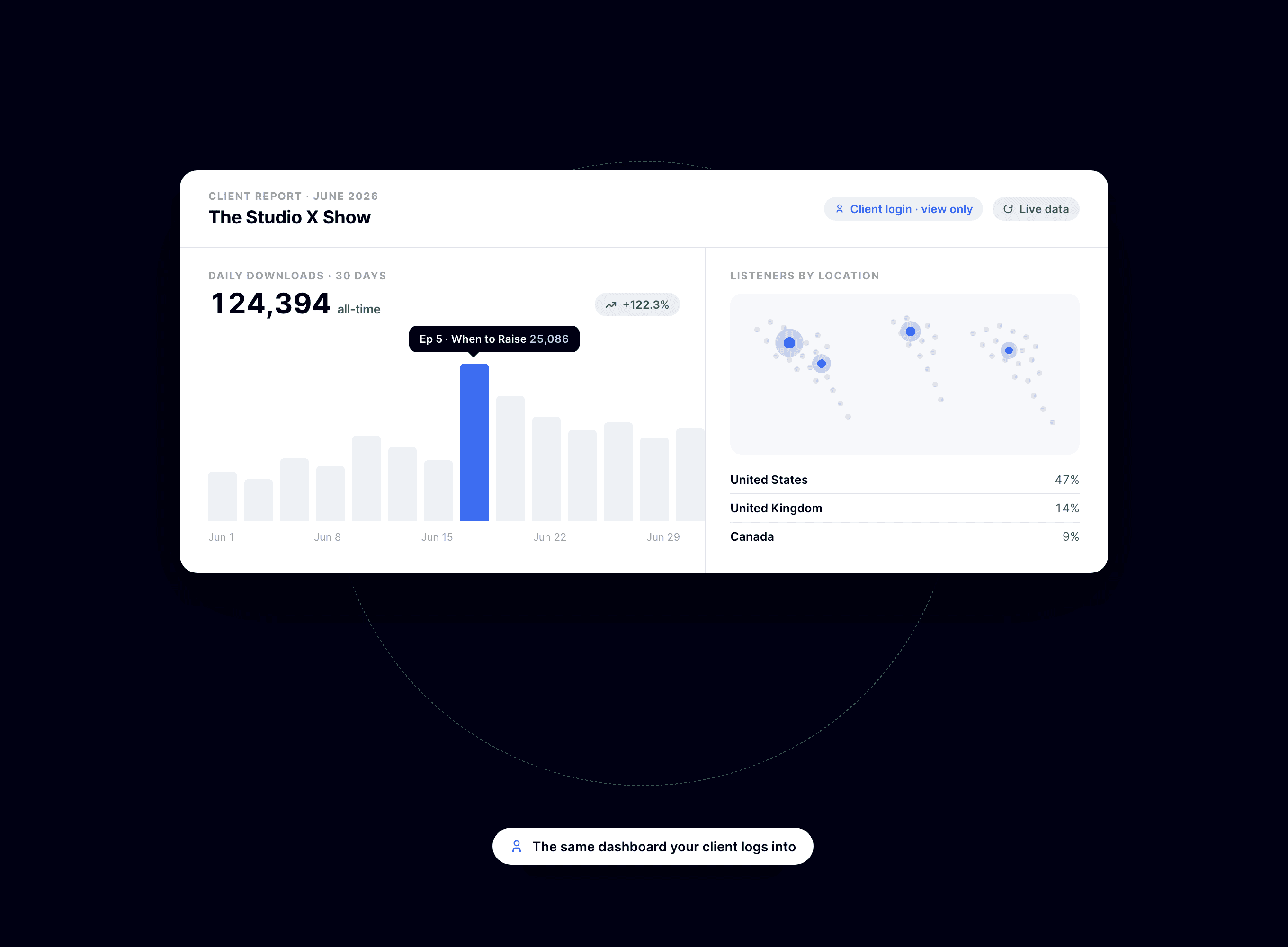
The best report is the one you never have to send. Invite the client into their show’s workspace as a member: they see daily charts, 7 and 30-day deltas, and the listener map whenever they’re curious — without any ability to touch settings or billing.
This kills the Friday-afternoon “can you send updated numbers?” email forever. It also builds trust: you’re visibly not hiding anything.
Because BuzzyPod seats are unlimited on the $10/month flat plan, adding the client, their assistant, and their marketing lead costs you nothing extra. Per-seat tools quietly punish exactly this kind of transparency.
One workspace per client, always
Never mix client shows in one account. Each BuzzyPod show gets its own workspace and its own subscription, which means each client engagement has clean edges: its own team list, its own analytics, its own guest releases.
That structure pays off twice — during the engagement, when staff can be invited per show instead of per agency, and at the end, when the whole thing can be handed over intact.
The clean offboarding checklist
Contracts end. Agencies get judged on how gracefully. Work the list:
Export the data: performance rankings, episode timelines, daily audience, and the year-in-review CSV.
Hand over the signed guest releases — every executed PDF, each sealed with its SHA-256 hash and audit trail, already sits in the show’s records.
Transfer ownership of the workspace to the client, or promote their team to the right roles.
Revoke your agency staff’s access the day the contract ends — not next sprint.
Send a one-page handoff note: where everything lives, what’s pending, who signed what.
The releases matter more than people think. If the client ever repurposes old episodes, they need proof every guest consented — and “our old agency had those somewhere” is not proof.
What lives outside the toolkit
For booking calendars, project boards, and edit review, use whatever generic tools your team already likes — scheduling links, shared docs, your editor of choice. The agency edge isn’t exotic software; it’s that your reporting is verifiable, your access is per-person, and your exits are tidy.
Conclusion
Agencies win renewals on trust, and trust is built from small operational habits: real exports, transparent access, and offboarding that takes an afternoon instead of a month.
If your client shows currently share one login and a screenshots folder, a BuzzyPod workspace per client — flat $10/month, unlimited seats, 14-day trial — is a cheap way to look as professional as your audio sounds.
Related reading
Introduction
Running client shows is a different sport from running your own. A podcast agency toolkit isn’t just editing software — it’s the boring machinery of reporting, access, and handoffs that decides whether clients renew or ghost.
Most agencies nail the creative work and improvise the operations. Reports are screenshots pasted into slides. Clients share the agency’s logins, or worse, the agency shares the client’s. Offboarding means someone “gets around to” changing passwords.
Here’s how to tighten all three — reporting, access, and the exit — so every engagement ends as professionally as it started.
Key takeaway
Send clients real data exports, not screenshots of dashboards.
Give clients their own view access instead of monthly report theater.
Keep every client show in its own workspace so contracts stay untangled.
Offboarding is a checklist: revoke access, export data, hand over signed releases.
Flat per-show pricing beats per-seat pricing when you’re staffing client accounts.
Reporting clients actually trust
Screenshots age instantly and invite suspicion — a cropped chart could say anything. Data files don’t argue.
BuzzyPod’s analytics run on OP3, so download counts are cross-app and independently measured — a useful phrase in client conversations. The CSV exports map neatly onto the questions clients actually ask:
Performance rankings — “which episodes worked?”
Episode timelines — “how does a typical episode decay after launch?”
Daily audience — “are we growing month over month?”
Year-in-review — “what do I tell my board?”
Attach the CSV to your monthly summary. Clients who can open the raw numbers stop wondering what the deck left out.
Give clients a login, not a slideshow
The best report is the one you never have to send. Invite the client into their show’s workspace as a member: they see daily charts, 7 and 30-day deltas, and the listener map whenever they’re curious — without any ability to touch settings or billing.
This kills the Friday-afternoon “can you send updated numbers?” email forever. It also builds trust: you’re visibly not hiding anything.
Because BuzzyPod seats are unlimited on the $10/month flat plan, adding the client, their assistant, and their marketing lead costs you nothing extra. Per-seat tools quietly punish exactly this kind of transparency.
One workspace per client, always
Never mix client shows in one account. Each BuzzyPod show gets its own workspace and its own subscription, which means each client engagement has clean edges: its own team list, its own analytics, its own guest releases.
That structure pays off twice — during the engagement, when staff can be invited per show instead of per agency, and at the end, when the whole thing can be handed over intact.
The clean offboarding checklist
Contracts end. Agencies get judged on how gracefully. Work the list:
Export the data: performance rankings, episode timelines, daily audience, and the year-in-review CSV.
Hand over the signed guest releases — every executed PDF, each sealed with its SHA-256 hash and audit trail, already sits in the show’s records.
Transfer ownership of the workspace to the client, or promote their team to the right roles.
Revoke your agency staff’s access the day the contract ends — not next sprint.
Send a one-page handoff note: where everything lives, what’s pending, who signed what.
The releases matter more than people think. If the client ever repurposes old episodes, they need proof every guest consented — and “our old agency had those somewhere” is not proof.
What lives outside the toolkit
For booking calendars, project boards, and edit review, use whatever generic tools your team already likes — scheduling links, shared docs, your editor of choice. The agency edge isn’t exotic software; it’s that your reporting is verifiable, your access is per-person, and your exits are tidy.
Conclusion
Agencies win renewals on trust, and trust is built from small operational habits: real exports, transparent access, and offboarding that takes an afternoon instead of a month.
If your client shows currently share one login and a screenshots folder, a BuzzyPod workspace per client — flat $10/month, unlimited seats, 14-day trial — is a cheap way to look as professional as your audio sounds.
Related reading
Introduction
Running client shows is a different sport from running your own. A podcast agency toolkit isn’t just editing software — it’s the boring machinery of reporting, access, and handoffs that decides whether clients renew or ghost.
Most agencies nail the creative work and improvise the operations. Reports are screenshots pasted into slides. Clients share the agency’s logins, or worse, the agency shares the client’s. Offboarding means someone “gets around to” changing passwords.
Here’s how to tighten all three — reporting, access, and the exit — so every engagement ends as professionally as it started.
Key takeaway
Send clients real data exports, not screenshots of dashboards.
Give clients their own view access instead of monthly report theater.
Keep every client show in its own workspace so contracts stay untangled.
Offboarding is a checklist: revoke access, export data, hand over signed releases.
Flat per-show pricing beats per-seat pricing when you’re staffing client accounts.
Reporting clients actually trust
Screenshots age instantly and invite suspicion — a cropped chart could say anything. Data files don’t argue.
BuzzyPod’s analytics run on OP3, so download counts are cross-app and independently measured — a useful phrase in client conversations. The CSV exports map neatly onto the questions clients actually ask:
Performance rankings — “which episodes worked?”
Episode timelines — “how does a typical episode decay after launch?”
Daily audience — “are we growing month over month?”
Year-in-review — “what do I tell my board?”
Attach the CSV to your monthly summary. Clients who can open the raw numbers stop wondering what the deck left out.
Give clients a login, not a slideshow
The best report is the one you never have to send. Invite the client into their show’s workspace as a member: they see daily charts, 7 and 30-day deltas, and the listener map whenever they’re curious — without any ability to touch settings or billing.
This kills the Friday-afternoon “can you send updated numbers?” email forever. It also builds trust: you’re visibly not hiding anything.
Because BuzzyPod seats are unlimited on the $10/month flat plan, adding the client, their assistant, and their marketing lead costs you nothing extra. Per-seat tools quietly punish exactly this kind of transparency.
One workspace per client, always
Never mix client shows in one account. Each BuzzyPod show gets its own workspace and its own subscription, which means each client engagement has clean edges: its own team list, its own analytics, its own guest releases.
That structure pays off twice — during the engagement, when staff can be invited per show instead of per agency, and at the end, when the whole thing can be handed over intact.
The clean offboarding checklist
Contracts end. Agencies get judged on how gracefully. Work the list:
Export the data: performance rankings, episode timelines, daily audience, and the year-in-review CSV.
Hand over the signed guest releases — every executed PDF, each sealed with its SHA-256 hash and audit trail, already sits in the show’s records.
Transfer ownership of the workspace to the client, or promote their team to the right roles.
Revoke your agency staff’s access the day the contract ends — not next sprint.
Send a one-page handoff note: where everything lives, what’s pending, who signed what.
The releases matter more than people think. If the client ever repurposes old episodes, they need proof every guest consented — and “our old agency had those somewhere” is not proof.
What lives outside the toolkit
For booking calendars, project boards, and edit review, use whatever generic tools your team already likes — scheduling links, shared docs, your editor of choice. The agency edge isn’t exotic software; it’s that your reporting is verifiable, your access is per-person, and your exits are tidy.
Conclusion
Agencies win renewals on trust, and trust is built from small operational habits: real exports, transparent access, and offboarding that takes an afternoon instead of a month.
If your client shows currently share one login and a screenshots folder, a BuzzyPod workspace per client — flat $10/month, unlimited seats, 14-day trial — is a cheap way to look as professional as your audio sounds.

