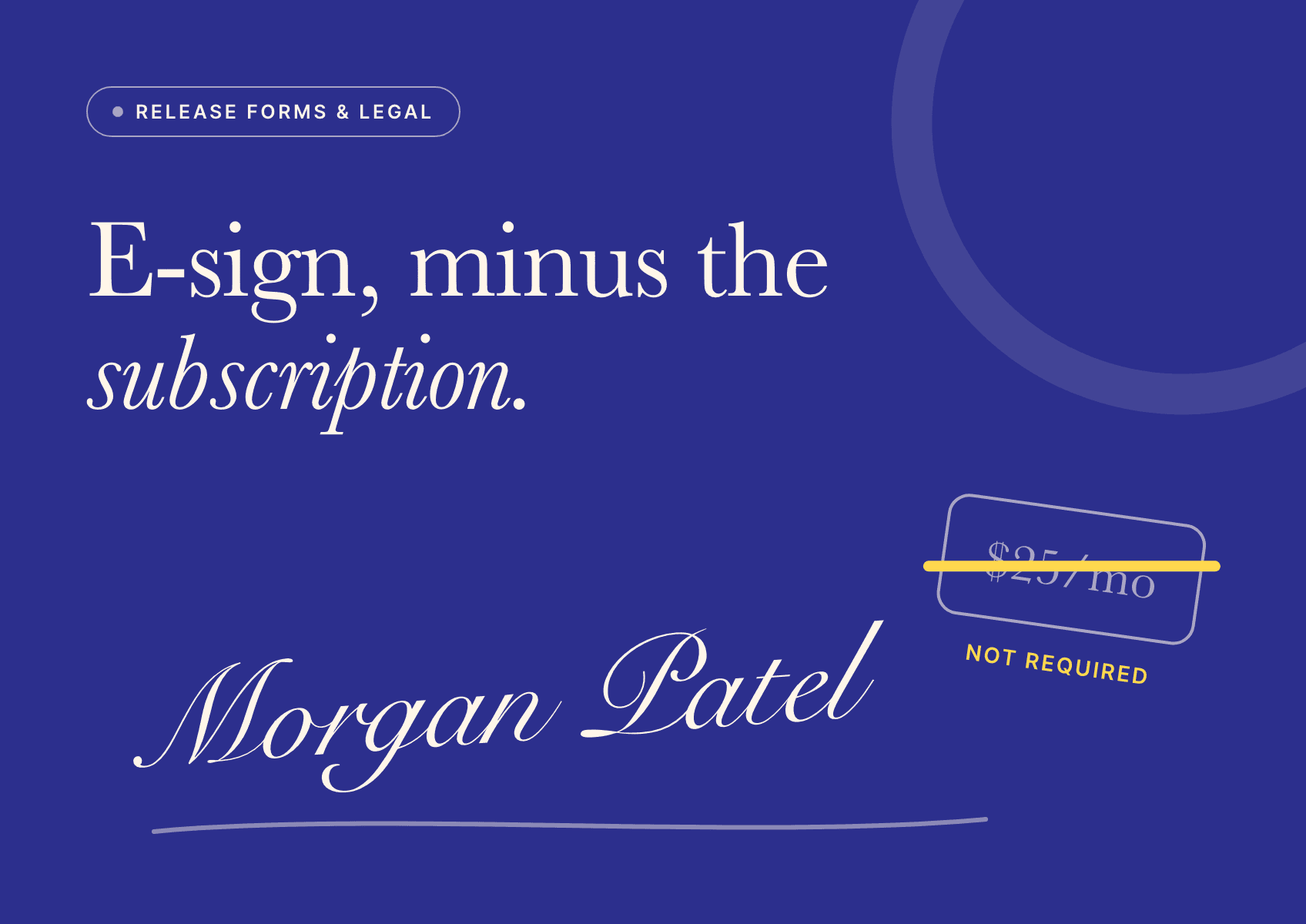
DocuSign alternatives for podcasters: e-sign guest releases without the subscription

Nathaniel DeSantis
Release Forms & Legal
Introduction
If you’ve looked into e-signing guest releases, you’ve probably priced out DocuSign and felt a little silly. It’s excellent software — for sales teams closing enterprise contracts. Hence the search for DocuSign alternatives for podcasters: something that signs a one-page release without the per-seat pricing and procurement-grade feature set.
To be fair to DocuSign: it’s a mature, trusted platform that handles complex multi-party agreements, approval chains, and compliance requirements most podcasters will never encounter. That’s exactly the issue — you’re paying for a truck to carry an envelope.
This post breaks down what podcasters actually need from an e-signature workflow, and how to get it without an enterprise subscription.
Key takeaway
DocuSign is built for general business contracts — powerful, but priced and designed for teams, not podcast guests.
Podcasters sign one document type, repeatedly: the guest release.
You still bring your own template to a general e-sign tool — the legal drafting problem remains yours.
What matters for releases: a ready-made template, frictionless guest signing, audit trails, and automatic PDF delivery.
Purpose-built beats general-purpose when your workflow is this narrow.
What DocuSign is actually for
DocuSign and similar platforms are horizontal tools: they’ll route any document to any set of signers with approval workflows, integrations, and admin controls. Legal teams, real estate agents, and HR departments genuinely need all of that.
A podcaster’s signing life looks nothing like that. It’s one document type, one signer per document, over and over. The heavyweight machinery doesn’t hurt you — you just pay for it without using it.
Where the mismatch bites
A few specific places where general e-sign tools fit podcasters poorly:
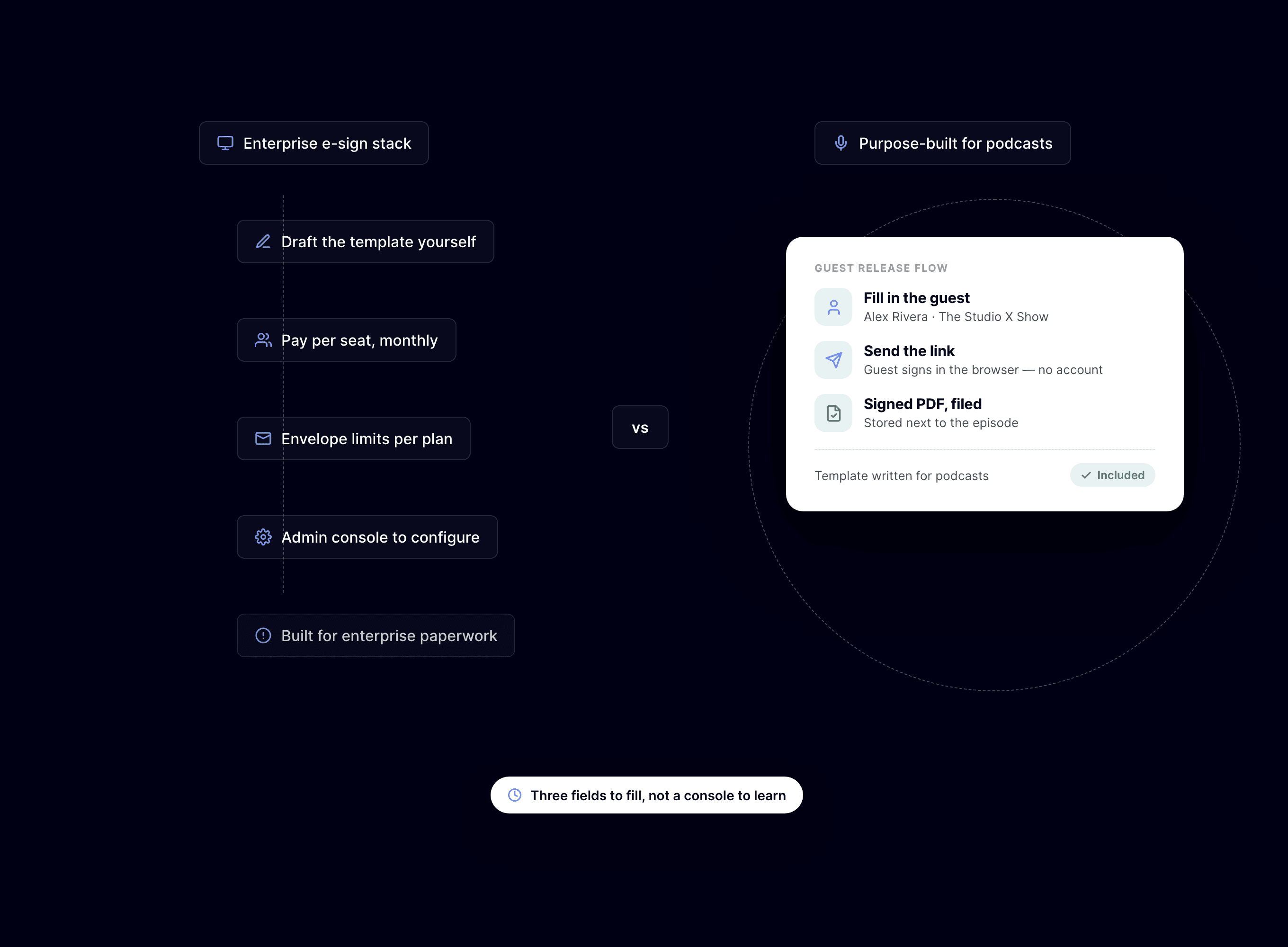
Per-seat pricing: costs scale with team members, and a co-host or editor who occasionally sends releases needs their own seat.
Envelope limits: lower tiers often cap how many documents you can send, which is exactly backwards for a weekly show.
No podcast template: you get a blank canvas — writing the actual release agreement is still your problem.
Generic workflow: fields, roles, and routing options designed for contracts, not for “send my guest a release.”
Setup overhead: template creation, field placement, and signer roles to configure before you send anything.
None of these are flaws in DocuSign. They’re symptoms of using a general tool for a narrow job.
The template problem nobody mentions
Here’s the part the e-signature comparison charts skip: an e-sign tool signs whatever you upload. The hard part for a podcaster isn’t collecting the signature — it’s having a decent release agreement to sign in the first place.
With a general tool, your options are hunting down a free template of unknown quality or paying a lawyer to draft one. Either way, the subscription didn’t solve your actual problem; it solved the last five percent of it.
Usual caveat applies: this is general information, not legal advice — if your show has unusual circumstances, run your release past a lawyer.
What podcasters actually need
Strip the requirement down to its essentials and the shopping list is short:
A ready-written podcast release, so you’re not drafting or template-hunting.
Minimal per-guest setup: name, email, governing state — done.
Guest signing that works from an email link on any device, with no account or app.
Legally sound e-signatures with a timestamped audit trail and tamper-evidence.
Automatic delivery of the executed PDF to both parties.
A status view so you know who’s signed and who needs a nudge.
Anything beyond this list is weight, not value, for a podcast workflow.
The purpose-built option
This is the niche BuzzyPod was built for. The release agreement is already written and podcast-specific: you fill in your show’s name, the guest’s name and email, and the governing US state, with a live PDF preview as you go. Drafts autosave, you sign as the show’s representative with a typed signature, and your guest gets a secure link to sign on any device.
The executed PDF goes to both parties automatically, sealed with a SHA-256 hash and backed by an audit trail logging created, sent, viewed, and signed events with timestamps. Pricing is $10/month flat with unlimited team seats — no per-envelope math, no seat licenses for your editor.
Conclusion
DocuSign is great software solving a problem you mostly don’t have. For podcast guest releases, the winning setup is a purpose-built flow: template included, guest signing frictionless, records automatic.
If that sounds right-sized, BuzzyPod’s built-in release form with e-signing is $10/month with a 14-day free trial — about the cost of one coffee, not one enterprise seat.
Related reading
Introduction
If you’ve looked into e-signing guest releases, you’ve probably priced out DocuSign and felt a little silly. It’s excellent software — for sales teams closing enterprise contracts. Hence the search for DocuSign alternatives for podcasters: something that signs a one-page release without the per-seat pricing and procurement-grade feature set.
To be fair to DocuSign: it’s a mature, trusted platform that handles complex multi-party agreements, approval chains, and compliance requirements most podcasters will never encounter. That’s exactly the issue — you’re paying for a truck to carry an envelope.
This post breaks down what podcasters actually need from an e-signature workflow, and how to get it without an enterprise subscription.
Key takeaway
DocuSign is built for general business contracts — powerful, but priced and designed for teams, not podcast guests.
Podcasters sign one document type, repeatedly: the guest release.
You still bring your own template to a general e-sign tool — the legal drafting problem remains yours.
What matters for releases: a ready-made template, frictionless guest signing, audit trails, and automatic PDF delivery.
Purpose-built beats general-purpose when your workflow is this narrow.
What DocuSign is actually for
DocuSign and similar platforms are horizontal tools: they’ll route any document to any set of signers with approval workflows, integrations, and admin controls. Legal teams, real estate agents, and HR departments genuinely need all of that.
A podcaster’s signing life looks nothing like that. It’s one document type, one signer per document, over and over. The heavyweight machinery doesn’t hurt you — you just pay for it without using it.
Where the mismatch bites
A few specific places where general e-sign tools fit podcasters poorly:
Per-seat pricing: costs scale with team members, and a co-host or editor who occasionally sends releases needs their own seat.
Envelope limits: lower tiers often cap how many documents you can send, which is exactly backwards for a weekly show.
No podcast template: you get a blank canvas — writing the actual release agreement is still your problem.
Generic workflow: fields, roles, and routing options designed for contracts, not for “send my guest a release.”
Setup overhead: template creation, field placement, and signer roles to configure before you send anything.
None of these are flaws in DocuSign. They’re symptoms of using a general tool for a narrow job.
The template problem nobody mentions
Here’s the part the e-signature comparison charts skip: an e-sign tool signs whatever you upload. The hard part for a podcaster isn’t collecting the signature — it’s having a decent release agreement to sign in the first place.
With a general tool, your options are hunting down a free template of unknown quality or paying a lawyer to draft one. Either way, the subscription didn’t solve your actual problem; it solved the last five percent of it.
Usual caveat applies: this is general information, not legal advice — if your show has unusual circumstances, run your release past a lawyer.
What podcasters actually need
Strip the requirement down to its essentials and the shopping list is short:
A ready-written podcast release, so you’re not drafting or template-hunting.
Minimal per-guest setup: name, email, governing state — done.
Guest signing that works from an email link on any device, with no account or app.
Legally sound e-signatures with a timestamped audit trail and tamper-evidence.
Automatic delivery of the executed PDF to both parties.
A status view so you know who’s signed and who needs a nudge.
Anything beyond this list is weight, not value, for a podcast workflow.
The purpose-built option
This is the niche BuzzyPod was built for. The release agreement is already written and podcast-specific: you fill in your show’s name, the guest’s name and email, and the governing US state, with a live PDF preview as you go. Drafts autosave, you sign as the show’s representative with a typed signature, and your guest gets a secure link to sign on any device.
The executed PDF goes to both parties automatically, sealed with a SHA-256 hash and backed by an audit trail logging created, sent, viewed, and signed events with timestamps. Pricing is $10/month flat with unlimited team seats — no per-envelope math, no seat licenses for your editor.
Conclusion
DocuSign is great software solving a problem you mostly don’t have. For podcast guest releases, the winning setup is a purpose-built flow: template included, guest signing frictionless, records automatic.
If that sounds right-sized, BuzzyPod’s built-in release form with e-signing is $10/month with a 14-day free trial — about the cost of one coffee, not one enterprise seat.
Related reading
Introduction
If you’ve looked into e-signing guest releases, you’ve probably priced out DocuSign and felt a little silly. It’s excellent software — for sales teams closing enterprise contracts. Hence the search for DocuSign alternatives for podcasters: something that signs a one-page release without the per-seat pricing and procurement-grade feature set.
To be fair to DocuSign: it’s a mature, trusted platform that handles complex multi-party agreements, approval chains, and compliance requirements most podcasters will never encounter. That’s exactly the issue — you’re paying for a truck to carry an envelope.
This post breaks down what podcasters actually need from an e-signature workflow, and how to get it without an enterprise subscription.
Key takeaway
DocuSign is built for general business contracts — powerful, but priced and designed for teams, not podcast guests.
Podcasters sign one document type, repeatedly: the guest release.
You still bring your own template to a general e-sign tool — the legal drafting problem remains yours.
What matters for releases: a ready-made template, frictionless guest signing, audit trails, and automatic PDF delivery.
Purpose-built beats general-purpose when your workflow is this narrow.
What DocuSign is actually for
DocuSign and similar platforms are horizontal tools: they’ll route any document to any set of signers with approval workflows, integrations, and admin controls. Legal teams, real estate agents, and HR departments genuinely need all of that.
A podcaster’s signing life looks nothing like that. It’s one document type, one signer per document, over and over. The heavyweight machinery doesn’t hurt you — you just pay for it without using it.
Where the mismatch bites
A few specific places where general e-sign tools fit podcasters poorly:
Per-seat pricing: costs scale with team members, and a co-host or editor who occasionally sends releases needs their own seat.
Envelope limits: lower tiers often cap how many documents you can send, which is exactly backwards for a weekly show.
No podcast template: you get a blank canvas — writing the actual release agreement is still your problem.
Generic workflow: fields, roles, and routing options designed for contracts, not for “send my guest a release.”
Setup overhead: template creation, field placement, and signer roles to configure before you send anything.
None of these are flaws in DocuSign. They’re symptoms of using a general tool for a narrow job.
The template problem nobody mentions
Here’s the part the e-signature comparison charts skip: an e-sign tool signs whatever you upload. The hard part for a podcaster isn’t collecting the signature — it’s having a decent release agreement to sign in the first place.
With a general tool, your options are hunting down a free template of unknown quality or paying a lawyer to draft one. Either way, the subscription didn’t solve your actual problem; it solved the last five percent of it.
Usual caveat applies: this is general information, not legal advice — if your show has unusual circumstances, run your release past a lawyer.
What podcasters actually need
Strip the requirement down to its essentials and the shopping list is short:
A ready-written podcast release, so you’re not drafting or template-hunting.
Minimal per-guest setup: name, email, governing state — done.
Guest signing that works from an email link on any device, with no account or app.
Legally sound e-signatures with a timestamped audit trail and tamper-evidence.
Automatic delivery of the executed PDF to both parties.
A status view so you know who’s signed and who needs a nudge.
Anything beyond this list is weight, not value, for a podcast workflow.
The purpose-built option
This is the niche BuzzyPod was built for. The release agreement is already written and podcast-specific: you fill in your show’s name, the guest’s name and email, and the governing US state, with a live PDF preview as you go. Drafts autosave, you sign as the show’s representative with a typed signature, and your guest gets a secure link to sign on any device.
The executed PDF goes to both parties automatically, sealed with a SHA-256 hash and backed by an audit trail logging created, sent, viewed, and signed events with timestamps. Pricing is $10/month flat with unlimited team seats — no per-envelope math, no seat licenses for your editor.
Conclusion
DocuSign is great software solving a problem you mostly don’t have. For podcast guest releases, the winning setup is a purpose-built flow: template included, guest signing frictionless, records automatic.
If that sounds right-sized, BuzzyPod’s built-in release form with e-signing is $10/month with a 14-day free trial — about the cost of one coffee, not one enterprise seat.

